
If you’re reading this, you’re probably already sending postcards to a neighborhood and wondering why you’re not getting more real estate listings.
Or maybe you’re thinking about starting a farm and trying to figure out which neighborhood to pick. Either way, most of the advice about geographic farming (also called neighborhood farming) boils down to “choose an area you like and send mailers consistently.”
That’s not wrong. But it’s incomplete.
The agents who actually dominate a farm aren’t the ones with the prettiest postcards. They’re the ones who did the math before they spent their first dollar, and then layered a digital presence on top of their physical one so they’re impossible to ignore.
I know this because one of my clients in Las Vegas has been farming with direct mail for years and it works extremely well for him, especially with older homeowners. But when I looked at what he was doing versus what most agents do, the difference wasn’t the mailer design. It was the neighborhood selection and the follow-through.
So let’s talk about the math that determines whether your farm will actually produce, and the digital strategy that turns a good farm into a dominant one.
Key Takeaways
- Turnover rate is the single most important metric for evaluating a farm. Below 3% and you’re fighting for scraps. 6% or higher is where the money is.
- Absorption rate tells you how fast inventory moves. Under 3 months means your digital presence needs to be faster than your mailer schedule.
- Traditional postcards still work, especially with Baby Boomer homeowners who control the majority of residential real estate wealth
- Adding a digital layer (local SEO, Google Business Profile, neighborhood content) to your physical farming makes your mailers 3x more effective because you’re everywhere they look, not just in their mailbox
- The agents who own a neighborhood in 2026 aren’t choosing between physical and digital farming. They’re doing both.
The Math Most Agents Skip Before Picking a Farm
Here’s where most “real estate farming” guides fail you. They tell you to pick a neighborhood with 500-2,000 homes, send consistent mailers, and wait 6-12 months for results.
They never tell you how to figure out if that neighborhood is actually worth farming in the first place.
Two numbers will save you from wasting thousands of dollars on a farm that was never going to produce. Most agents have never calculated either one.
Turnover Rate: The “Is This Farm Alive?” Test
The turnover rate tells you what percentage of homes in a neighborhood sell each year. This is the single most important number in your entire farming strategy.
The formula: (Number of homes sold in the past 12 months ÷ Total homes in the neighborhood) × 100 = Turnover Rate.
The benchmarks:
- 1-2% = Dead farm. You’re fighting every agent in town for 5-10 deals a year. Walk away.
- 3-5% = Survivable. Enough activity to justify the investment if your cost per mailer is low.
- 6-10% = Gold mine. This is where top-producing agents build empires.
Let’s make this real. Say you’re evaluating two neighborhoods in Orange County:
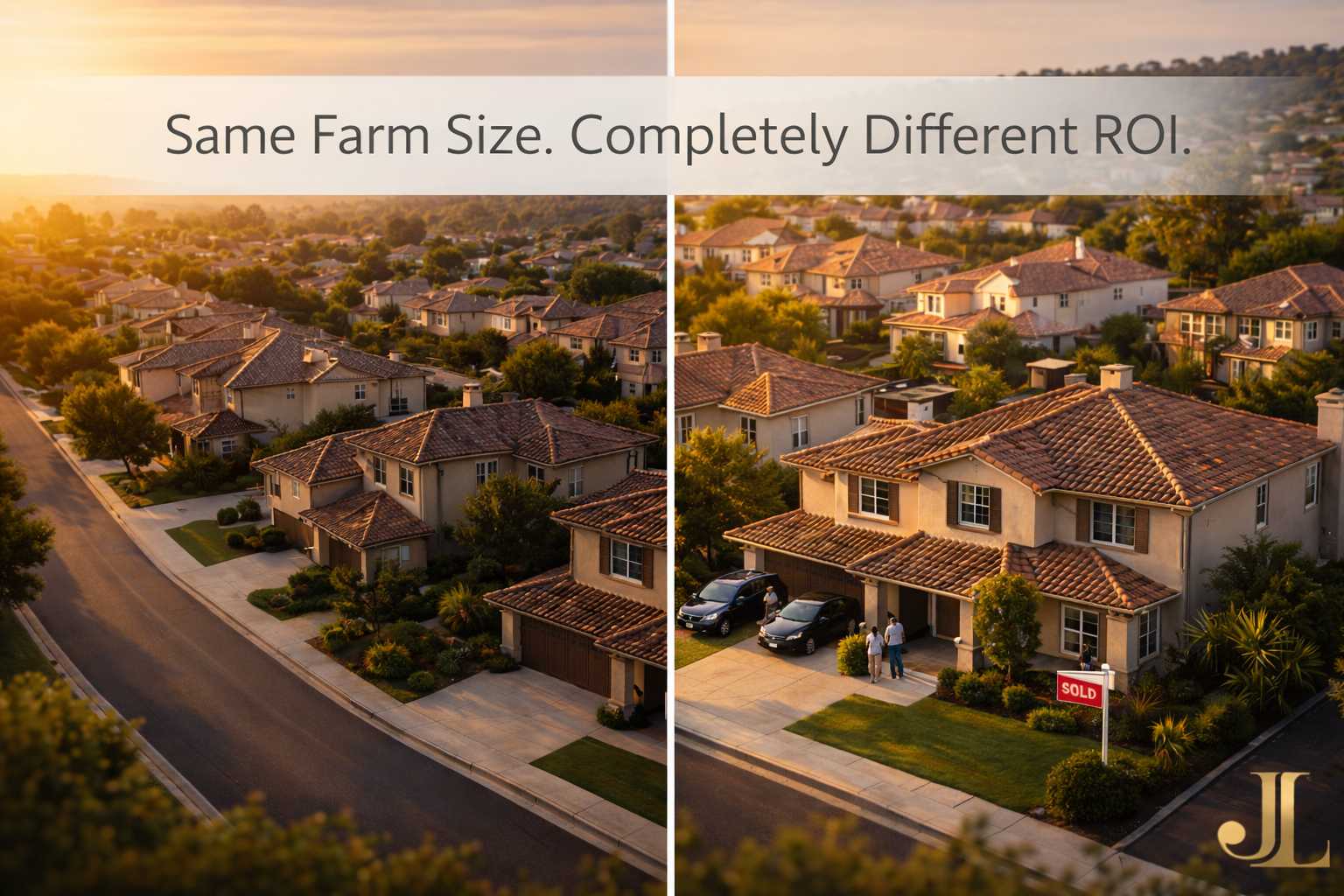
Neighborhood A: 500 homes, 5 sold last year. That’s a 1% turnover rate. You’d be spending $6,000-$10,000 a year on mailers to compete for 5 potential listings. Even if you won every single one (you won’t), the math barely works.
Neighborhood B: 500 homes, 30 sold last year. That’s a 6% turnover rate. Same mailer budget, but now you’re competing for 30 potential listings. Win even a third of those and you’ve built a serious pipeline.
Same size farm. Same mailer cost. Completely different ROI. This is why the neighborhood selection matters more than the postcard design.
Absorption Rate: The “How Fast Is This Market Moving?” Test
The absorption rate tells you how quickly the available inventory is selling. This matters because it determines how aggressive your farming cadence needs to be.
The formula: Total active listings ÷ Average monthly sales = Months of inventory (absorption rate)What the numbers mean:
- Under 3 months = Hot market. Homes are moving fast. Your digital presence needs to be ahead of your mailer schedule because by the time a postcard arrives, that listing is often already pending.
- 3-6 months = Balanced. Your monthly mailer cadence lines up well with how quickly homes are turning over.
- Over 6 months = Slow market. Mailers have more time to work, but you’ll need more touches before someone is ready to list.
You can pull both of these numbers from your MLS in about 15 minutes. If you’re not doing this before committing to a farm, you’re gambling. And real estate farming is supposed to be an investment, not a slot machine.
Why Traditional Farming Still Works (For the Right Audience)
Before we get into the digital side of this, let’s give credit where it’s due. Direct mail farming is not dead.
My Vegas client proves it every month. His mailers consistently generate listing appointments, and the reason is simple: his target demographic trusts the mailbox.
Baby Boomers and the Silent Generation control the majority of residential real estate wealth in the US. These homeowners grew up with physical mail as a primary communication channel. A well-designed postcard from a local agent feels personal and credible to them in a way that a Facebook ad never will.
And the data backs this up. According to the Association of National Advertisers (ANA) Response Rate Reports, direct mail to warm lists (past clients, your sphere) averages a 9% response rate. Even cold prospect lists, which is what most farming mailers are, pull 4.4% to 5%. Postcards specifically land between 2.7% and 4.4%.
For context, email marketing averages about 0.12%. That means even a cold farming postcard is roughly 37x more effective than email at generating a response.
Those aren’t “direct mail is dead” numbers. Those are “direct mail still works if you’re targeting the right people” numbers.
The key factors that make traditional farming work:
- Consistency. You need 12+ months of regular touches before most homeowners remember your name. Most agents quit after 3-4 months.
- Relevance. “Just Sold” cards with real local data outperform generic branding mailers every time.
- Targeting. A postcard to a high-turnover neighborhood with older homeowners is a smart investment. The same postcard to a neighborhood full of 30-year-olds who moved in two years ago is recycling bin material.
If your farm has the right turnover rate and the right demographic profile, postcards absolutely work. The problem is that postcards alone leave money on the table.
The Digital Layer That Makes Your Farm 3x More Effective
Here’s what happens when a homeowner in your farm gets your postcard and thinks, “Maybe it is time to sell.”
They don’t call the number on the card. Not right away. They Google you first.
They search your name. They search “real estate agent [neighborhood name].” They look at your reviews. They check your website. They compare you to whoever else shows up.
If you own the digital real estate for that neighborhood, you win twice. You’re in their mailbox AND you’re the first result when they search. That’s when the postcard converts, because the digital presence confirms everything the mailer promised.
Here’s how to build that digital layer:
Neighborhood-specific content on your website. Write about that neighborhood. Market updates, school information, what makes it unique, recent sales analysis. This is content marketing at its most targeted. One detailed neighborhood guide can rank in Google for years and drive organic leads long after your mailer budget runs out.
Google Business Profile optimization. Your Google Business Profile should reflect the areas you farm. Posts about recent sales in that neighborhood, photos from local events, reviews from clients in that area. When someone searches “[neighborhood] real estate agent,” your GBP should show up in the local pack.
Schema markup that ties you to the geography. Proper schema markup tells Google (and AI search engines like ChatGPT and Perplexity) that you are a real estate professional who serves specific areas. This is how you show up in AI-generated search results when someone asks “who’s the best agent in [your farm area].”
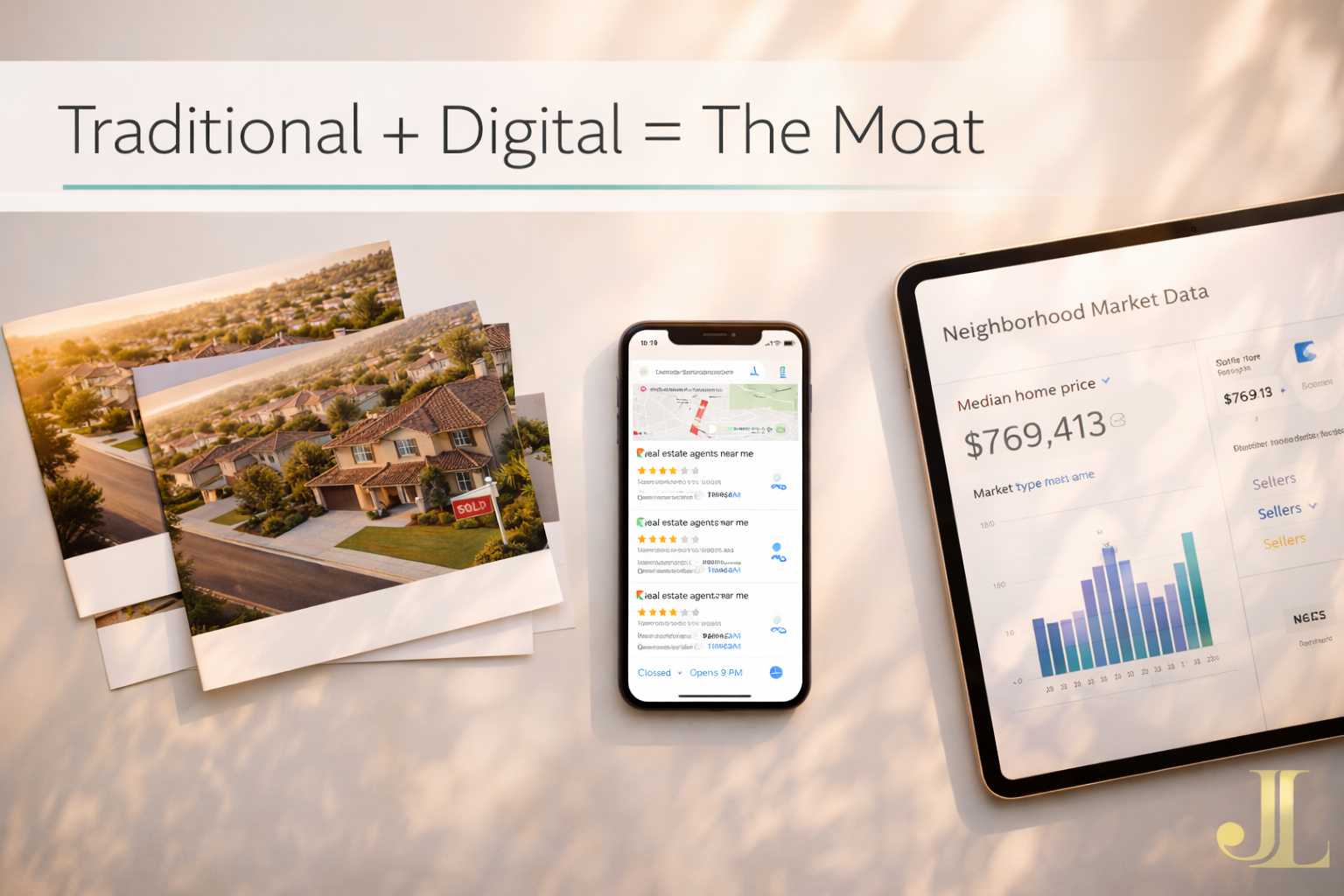
QR codes that bridge physical to digital. Instead of just putting your face and phone number on a mailer, include a QR code that links to a hyper-local market report or a short video walkthrough of recent sales in the neighborhood. Now your $0.75 postcard just drove a website visit, and that visitor enters your digital ecosystem where your local SEO does the follow-up for you.
There’s also an SEO benefit most real estate agents don’t realize: when 30, 40, 50 homeowners in a specific zip code scan that code and land on your website, you’re sending a massive geographic entity signal to Google. That clustering of visits from one area tells the algorithm your site is the local authority for that specific neighborhood. Your mailer isn’t just generating leads. It’s feeding your search rankings.
The Farming Evolution: How the Three Approaches Compare
| Factor | Traditional Only | Digital Only | Hybrid (The Moat) |
|---|---|---|---|
| Trust Factor | High with older homeowners, low with younger | Low initially (faceless online presence) | Highest. Physical proof + digital authority. |
| Speed to Contact | Slow. Monthly mailer, wait for a call. | Fast. Instant search, instant contact. | Optimal. Mailer triggers search, search finds you. |
| Cost per Impression | $0.50-$1.50 per household per touch | Near zero after initial content investment | Best ROI. Physical drives digital, digital compounds. |
| Lead Quality | Cold. “I got your card.” | Warm. “I found you on Google.” | Warmest. “I see you everywhere.” |
| Longevity | Stops working when you stop paying | Compounds over time, works while you sleep | Un-fireable. You own the neighborhood online AND offline. |
See the pattern? It’s the same principle behind why agents are moving away from Zillow and investing in assets they own. The best marketing strategy isn’t choosing between physical and digital. It’s making them work together, so you become the only agent the neighborhood thinks of.
How to Start (Or Fix) Your Farm in 2026
I’m not going to tell you to go buy 500 stamps tomorrow. The smart play is building this in phases:
The 3-phase farming plan:(1) Do the math first. Pull the turnover rate and absorption rate for your target neighborhoods from MLS. If the turnover is below 3%, pick a different neighborhood. This step alone saves most agents thousands.
(2) Build your digital presence for that neighborhood before you send a single mailer. Create a neighborhood page on your site, optimize your Google Business Profile for that area, and make sure your schema markup ties you to that geography.
(3) Launch your physical farming with a digital bridge. Every mailer should drive people to your website, whether that’s a QR code to a market report, a link to a neighborhood video, or an invitation to a local event you’re hosting. The mailer opens the door. Your digital presence closes it.
On phase one: spend 30 minutes in your MLS before you spend $1 on postcards. Pull the sold data for the past 12 months, count the total homes, do the division. If an agent had done this exercise before farming a 1% turnover neighborhood for two years, they’d have saved $15,000 or more.
On phase two: this is where most agents skip straight to mailers and wonder why they don’t work. If a homeowner gets your postcard, searches your name, and finds nothing, you’ve wasted that impression. If they search and find your website ranking for “[neighborhood] market update,” your Google reviews, and your GBP listing with recent posts about their area, that postcard just became 3x more powerful.
On phase three: now you’re farming with a Velocity Moat. You’re in their mailbox, you’re in their search results, you’re in their Google Maps. Every channel reinforces the other. That’s not a farming strategy. That’s neighborhood dominance.
-
I detailed how this moat acts as a primary defense against the threat of AI in real estate in my recent deep dive on the future of the industry.
The agents who will own their farms in 2026 aren’t the ones with the biggest mailer budgets. They’re the ones who did the math, built the digital foundation, and made every postcard work harder by being impossible to miss online.
Want to see if your digital farm is actually growing anything? I put together a free 10-minute SEO audit you can run on your own site to check your local search visibility, Google Business Profile health, and whether your website is set up to convert the traffic your mailers are driving.And if you want a full analysis of your digital presence across your farm areas, I offer a comprehensive SEO audit specifically built for real estate professionals.
Your farm is a business. Make sure the digital side is pulling its weight.
