
Irvine’s #1 Real Estate Team Gets 95 Organic Visitors a Month. Here’s What That’s Costing Them.
Let Me Start by Giving Credit Where It’s Due
Irene and Ricky Zhang are legitimate. The husband‑and‑wife team behind the Irene and Ricky Zhang Real Estate Group closed 76 transactions in the past 12 months in Irvine, according to Zillow, with prices ranging from 535,000 to 9.2 million dollars and an average sale price of 2.1 million dollars.
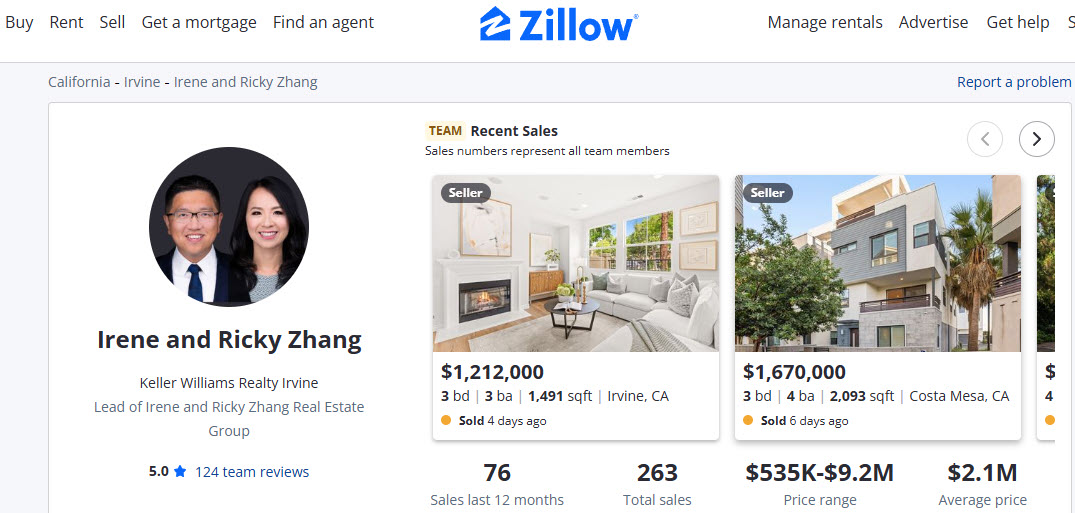
Realtor.com shows 47 transactions over a similar window; the discrepancy likely reflects how each platform counts dual‑representation deals. Either way, they have been recognized as Irvine’s number one listing agents by units in both 2024 and 2025. They are fluent in English, Mandarin, and Cantonese, which gives them an enormous advantage in a market where a significant portion of buyers have international connections. Their client reviews are exceptional.
By every traditional real estate metric, they are running an elite operation.
Google sends them 95 visitors a month.
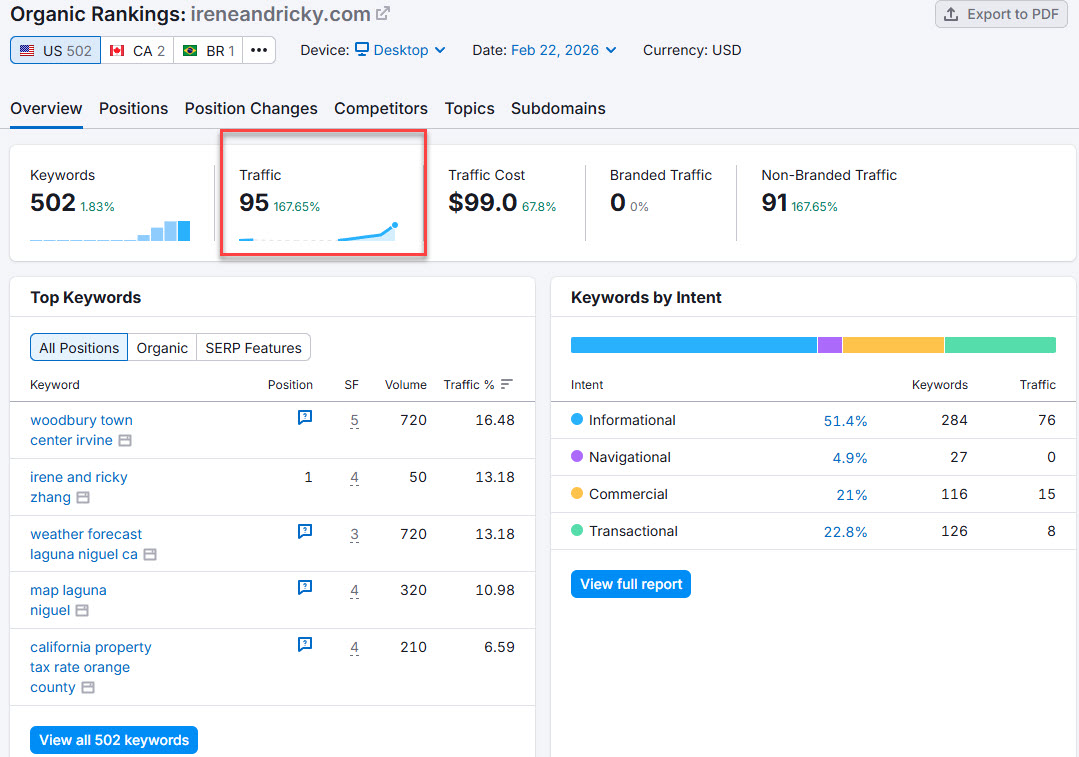
That number is not an estimate. It is pulled directly from Semrush’s domain analysis of ireneandricky.com, run February 23, 2026. For context, a well‑optimized blog post about a single Irvine neighborhood can generate more organic traffic than their entire website.
This is not a knock on Irene and Ricky. It is a data point that reveals something important about how even the best real estate operators in competitive markets are leaving significant lead generation on the table.
What Buyers Are Actually Searching in Irvine
Before getting into the numbers, it helps to understand how buyers actually search in a market like Irvine.
Most agents assume buyers search the way agents think about their market: “Irvine homes for sale,” “Irvine realtor,” “Irvine real estate agent.” These terms exist and they have volume, but they are dominated by Zillow, Realtor.com, Redfin, and other national portals with Domain Authority scores above 85. A local agent competing for “Irvine homes for sale” (880 monthly searches) is fighting a battle they cannot win.
The opportunity is not there.
The opportunity is in how buyers actually search once they have decided on Irvine and need to choose a neighborhood. That is where national portals are weak and local expertise wins.
Here is what that looks like in practice:
| Search query | Monthly volume | Competition level |
|---|---|---|
| “Irvine homes for sale” | 880 | Extreme (Zillow/portals) |
| “Woodbury Irvine homes for sale” | 70 | Low |
| “Orchard Hills Irvine CA” | 70 | Low |
| “Eastwood Irvine” | 110 | Low–medium |
| “Stonegate Irvine” | 90 | Low |
| “Great Park Irvine homes” | varies | Low |
| “Northwood Irvine neighborhoods” | varies | Low |
Individual neighborhood searches look small in isolation. Stack eight of them with first‑page rankings and you are capturing 400–600 monthly visitors who have already decided on Irvine and are now choosing where to live. These are not early‑stage researchers. They are weeks from making offers on homes averaging about 1.5 million dollars.
That is the search landscape. Now let us look at what Irvine’s top team actually owns.
The Teardown: ireneandricky.com
Here is the complete organic picture pulled from Semrush:
| Metric | Value |
|---|---|
| Monthly organic traffic | 95 visits |
| Total keywords ranking | 497 |
| Estimated traffic value | 99 dollars/month |
That last number is telling. Semrush estimates the monthly value of their organic traffic at 99 dollars. For comparison, a single Irvine buyer lead from Zillow Premier Agent costs 200–500 dollars.
Their entire organic search presence is worth less than one Zillow lead per month in estimated value.
Where Their Traffic Actually Comes From
Their single biggest traffic driver is their own name. “irene and ricky zhang” ranks number 1 and accounts for about 12% of their organic traffic. That is roughly 12 visitors a month finding them by searching their name directly. These are people who already know they exist.
The second biggest traffic driver is “Woodbury town center irvine” — a 720‑search‑per‑month term where they appear in a People Also Ask box. It is their one legitimate non‑branded placement, but a PAA snippet is passive visibility, not a lead funnel. Nobody clicking a People Also Ask result is looking for a listing agent.
The Neighborhood Rankings Gap
This is where the gap becomes concrete. Look at where they actually rank for the neighborhood terms that matter:
- “Woodbury Irvine homes for sale” – position 33
- “Orchard hills irvine” – position 98
- “Eastwood irvine” – positions 38 and 48
- “Irvine turtle rock” – positions 36 and 45
- “Stonegate irvine” – position 29
- “Homes for sale in orchard hills irvine ca” – position 35
Every single neighborhood they specialize in, they are on page 3, 4, or beyond. In SEO terms, these rankings might as well not exist. Studies consistently show that positions 1–3 capture roughly 60% of clicks; position 33 captures close to zero.
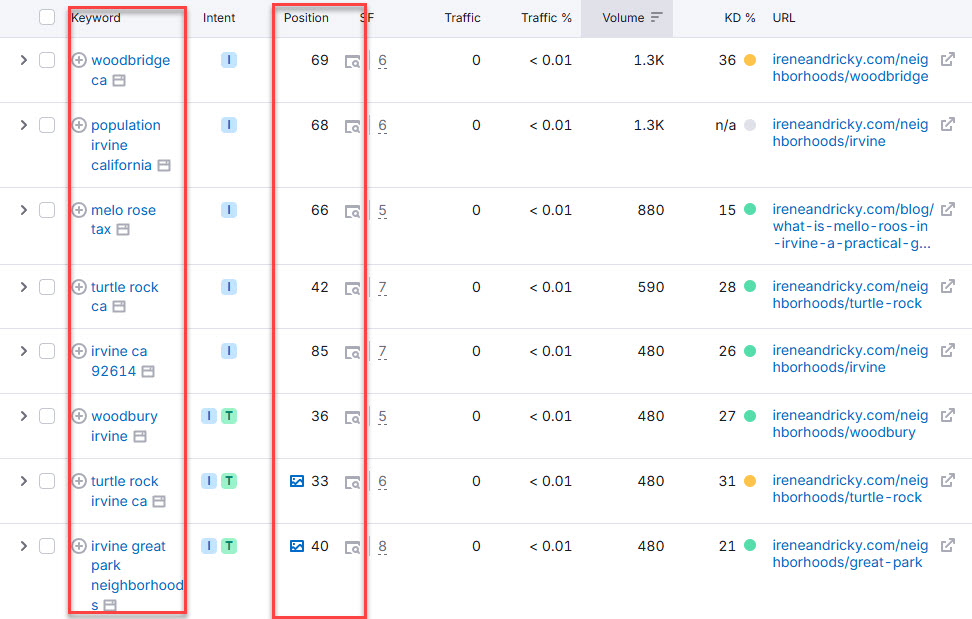
These are the neighborhoods showing up in their active listings right now — Woodbury, Great Park, Cypress, Northwood, Oak Creek. They know these markets better than almost anyone in Irvine. But when a buyer searches specifically for homes in those neighborhoods, Irene and Ricky are invisible.
The Mello‑Roos Near‑Miss
One interesting data point: they rank for multiple Mello‑Roos‑related searches:
- “What is mello roos” – position 30 (880 monthly searches)
- “What are mello roos taxes” – positions 14 and 21
- “Mello roos taxes” – position 44
- “Is mello roos only in california” – position 23
This is actually a smart content instinct. Mello‑Roos is a major concern for Irvine buyers because many neighborhoods carry significant special assessments, and it is the kind of hyper‑local knowledge question that national portals answer poorly. The problem is execution.
These pages are not driving meaningful traffic because they are not built out as comprehensive resources and they are not connected to a content architecture that funnels Mello‑Roos researchers toward neighborhood guides and ultimately toward a conversation.
The instinct was right. The infrastructure to capture it is not there.
The Backlink Reality
Their backlink profile tells a similar story. Their top referring domain is ireneandricky.homes — essentially themselves. Their second biggest source is muvzu.com, a moving‑company directory. Chinese‑language community directories like guruin.com appear, which makes sense given their clientele, but those are not driving search authority in the US Google index.
291 total backlinks across 141 referring domains. For a team doing nearly 80 million dollars in annual transaction volume, the digital footprint is minimal.
Zero Paid Search
They run no Google Ads. No paid search at all. This is not necessarily wrong — SEO is a better long‑term investment — but it does mean there is no paid safety net supplementing the organic gap. Every lead that is not coming from referrals is coming from somewhere other than their website.
What This Gap Is Actually Worth
Before getting into the math, here is the fundamental difference between how most Irvine agents generate leads and what organic search actually offers:
| Strategy | Ownership | Monthly cost | Lead cost | Long‑term ROI |
|---|---|---|---|---|
| Zillow Premier Agent | Rented | 3,000–20,000 dollars+ | 200–2,500 dollars+ | Zero (stop paying, leads stop) |
| Google Ads | Rented | Varies | 30–150 dollars | Moderate (builds no equity) |
| Organic SEO | Owned | One‑time build | 5–20 dollars after month 12 | High (compounds over years) |
The Zillow numbers come from luxury ZIP‑code data, which is exactly where Irvine agents compete. That 200–2,500‑dollar cost‑per‑connection figure is what agents in markets like Irvine are actually paying per lead, before conversion, before broker splits, before anything else.
Now let us put a number on what the organic gap is actually worth.
Irvine neighborhood searches collectively represent thousands of monthly searches for high‑intent buyers. A well‑optimized local agent website targeting six to eight Irvine neighborhoods can realistically capture 400–800 monthly organic visitors within 12 months of consistent execution; that is based on comparable markets I have tracked.
At a 2–3% visitor‑to‑lead conversion rate, that is 8–24 leads per month.
At Zillow’s reported average sale price of 2.1 million dollars for this team and a 2.5% commission, each closed transaction is worth approximately 52,500 dollars in gross commission. Even at Realtor.com’s more conservative average, you are still looking at around 37,500 dollars per close.
At 52,500 dollars per closed transaction, a single additional close from organic search pays for a year of SEO investment.
Even if only 10–15% of those leads convert to closed transactions, the math on organic search becomes significant quickly. The cost per organic lead after 12 months of SEO investment typically runs 5–20 dollars. The cost per Zillow lead in a luxury Irvine ZIP code runs 200–2,500 dollars, with no equity built for the future.
The difference between renting leads and owning search is not just a monthly‑budget question. It is a business‑asset question. Organic rankings compound. Zillow fees do not.
Sound familiar?
Most high‑producing agents in Irvine have the same blind spot. Strong referral pipeline. Weak organic presence. No content capturing the buyers who search before they ever call anyone.
If you are curious where your site actually stands, I do a comprehensive SEO audit — full competitive landscape, specific neighborhood keyword opportunities, and a prioritized action plan. It is the same analysis I ran on Irene and Ricky, applied to your market position.
I am currently scheduling audits for late April. If you want to know exactly what the data says about your site before a competitor does, this is the time to move.
Why This Happens to Top Producers
It would be easy to frame this as a mistake. It is not really.
Irene and Ricky built their business the way most top real estate producers in Irvine did: through community relationships, referrals, and a network strong enough to sustain 76 transactions a year without a single page‑one neighborhood ranking. For agents with strong ethnic‑community networks — and Irvine has a substantial one — this model works exceptionally well.
The vulnerability is not visible when the referral network is strong. It becomes visible when market conditions shift, when a key referral source moves or retires, or when a new competitor starts owning the neighborhood searches you have ignored for years.
The agent who builds the digital moat during the good years owns the market during the difficult ones. The agent who waits until the referral pipeline slows to start building organic presence starts from zero at exactly the wrong time.
This is the pattern I have seen repeatedly in competitive markets. The operators with the strongest offline networks are often the most exposed online, precisely because they have never needed to build that presence. When the market changes, they are starting from scratch against competitors who have been building for two years.
What the Data Says About the Broader Market
Irene and Ricky are not an anomaly. Their situation reflects something true about Irvine’s top‑producer landscape.
Pull the organic data on almost any high‑producing Irvine team and you will find the same picture. Strong branded search — people already know who they are. Weak or nonexistent neighborhood‑specific Google rankings. No content architecture connecting Irvine’s distinct communities to a systematic lead funnel.
The market is wide open at the neighborhood level. Woodbury, Great Park, Portola Springs, Orchard Hills, Northwood, Cypress Village — these communities have distinct buyer profiles, distinct price points, distinct lifestyle appeals. A buyer choosing between Woodbury and Orchard Hills has very different priorities than a buyer choosing between Northwood and Great Park.
That is content. That is expertise. That is exactly what national portals cannot replicate and what local agents are positioned to own.
Almost none of them do.
The AI Search Problem Nobody Is Talking About
Google’s organic rankings are only part of the story now.
When a high‑net‑worth buyer relocating from Shanghai, Hong Kong, or New York opens ChatGPT or Perplexity and asks “Who is the best luxury listing team in Irvine for a 3‑million‑dollar home?”, what happens?
AI search engines like ChatGPT and Perplexity build their recommendations from entity signals: citations in authoritative publications, mentions alongside established industry names, structured data on websites, and content that answers specific questions about specific markets. They are essentially asking: what does the web say about this entity?
For Irene and Ricky Zhang, the answer right now is mostly silence. A website with almost no search visibility and 95 organic visits a month has almost no content for AI search engines to cite. No neighborhood guides. No authoritative answers to the questions luxury buyers ask. No structured data signaling expertise in specific Irvine communities.
The agents who own neighborhood content in 2026 do not just rank on Google. They get recommended by AI search engines. For a market like Irvine, where a significant portion of buyers are doing research across multiple platforms before ever contacting an agent, this is not a future concern. It is a current one.
The Velocity Moat Problem
There is a compounding dynamic at work here that makes timing important.
The first agent in any Irvine neighborhood to build a comprehensive content presence — a real guide to Woodbury, a real guide to Orchard Hills, actual answers to what buyers search for — creates what I call a Velocity Moat. Google rewards established content with faster future rankings. A page that has been live for 18 months with consistent traffic signals ranks new content faster than a brand‑new site.
Right now, nobody truly owns Woodbury search. Nobody owns Orchard Hills search. Nobody owns Great Park neighborhood search at the level a dedicated local expert could.
That window does not stay open. The agent who builds this infrastructure in 2026 will be significantly harder to displace in 2028 than someone starting from scratch. The referral network that sustains 47–76 transactions a year today is a powerful asset — but it does not compound the way search authority does. Every month without a content strategy is a month a competitor could be building a moat that eventually cuts off organic discovery permanently.
What Good Looks Like
I am not going to walk through the entire playbook here — I have done that in detail in my 6‑Month Real Estate SEO Framework. But the short version looks like this:
A comprehensive “Living in Irvine” hub page (3,500–4,000 words) captures the informational searches and establishes topical authority. Individual neighborhood guides for Woodbury, Great Park, Orchard Hills, Portola Springs, Northwood, and Cypress Village each target the low‑competition, high‑intent searches that currently go unanswered. Comparison content (“Woodbury vs Orchard Hills,” “Irvine vs Tustin”) captures decision‑phase buyers. Supporting content on topics like Mello‑Roos, school boundaries, and HOA specifics builds the kind of local authority that neither Zillow nor ChatGPT can easily replicate.
The infrastructure takes six months to build meaningful momentum and the competitive moat it creates compounds from there.
The agents who build it now own Irvine neighborhood search for years. The agents who wait are building against someone who already has a head start.
Where to Start
If you have read this far, you already know what the data says about the Irvine market. The neighborhood searches are wide open. The agents who could own them are not building the content infrastructure to do it. That window is real, and it will not stay open indefinitely.
The question is what your own site looks like.
I do a comprehensive real estate SEO audit: a full competitive analysis of your current search presence, specific keyword opportunities in your target neighborhoods, a breakdown of what competitors are doing (and not doing), and a prioritized action plan you can actually execute. It is the same methodology behind this analysis, applied directly to your market position.
Comprehensive SEO Audit — 1,500 dollars
Includes: full organic‑visibility analysis, competitive landscape, neighborhood keyword map, technical gap review, and a written action plan. If you move forward with ongoing work, the audit fee applies toward your first month.
I am currently scheduling for late April and May. If your timing works, let’s look at your numbers.
Not ready for the full audit? The free 10‑Minute Real Estate SEO Audit is a DIY checklist that lets you run the same surface‑level checks I use before a professional audit — rankings, basics, obvious leaks — in about ten minutes.
Frequently Asked Questions: Real Estate SEO
Why is my real estate website not getting traffic?
Most real estate websites get almost no organic traffic because they target the wrong keywords. Broad terms like “Irvine homes for sale” are dominated by Zillow, Realtor.com, and Redfin — sites with Domain Authority scores above 85 that local agents cannot compete with. The opportunity is in neighborhood‑specific searches where national portals are weak and local expertise wins. If your site is not targeting those terms with dedicated content, Google has no reason to rank you.
What is local SEO for real estate agents?
Local SEO for real estate means building search visibility for the specific neighborhoods and communities you serve, not just your city name. It includes neighborhood guide pages, comparison content (“Woodbury vs Orchard Hills”), hyper‑local topics like Mello‑Roos or school boundaries, and a backlink profile from local and industry sources.
Is Zillow Premier Agent worth it compared to SEO?
Zillow Premier Agent costs 3,000–20,000 dollars or more per month in luxury ZIP codes, with lead costs running 200–2,500 dollars per connection before conversion. Organic SEO costs more upfront to build but delivers leads at 5–20 dollars each after month 12 — and unlike Zillow, those rankings do not disappear the moment you stop paying. For high‑volume agents in competitive markets, organic search is a business asset. Zillow is a recurring expense with no equity.
How long does real estate SEO take to work?
A well‑executed real estate SEO strategy targeting neighborhood‑specific keywords typically builds meaningful traffic within six months. The first 90 days establish the content architecture and technical foundation. Months three through six see rankings begin to move as Google indexes and evaluates the new content. By month 12, a properly built site targeting six to eight Irvine neighborhoods can realistically capture 400–800 monthly organic visitors — buyers actively searching for homes in your market.
What real estate SEO keywords should I target?
Skip the broad city terms and focus on neighborhood‑level searches. In Irvine, that means terms like “Woodbury Irvine homes for sale,” “Orchard Hills Irvine CA,” “Eastwood Irvine,” and “Stonegate Irvine” — searches with low competition and high buyer intent. Support those with informational content on local topics buyers actually research: Mello‑Roos taxes, school boundaries, HOA specifics, and neighborhood comparison guides.
