

Why Your Backlinks Aren’t Working (And How Entity SEO Fixes It)
I’m going to tell you why your backlinks aren’t moving the needle – and it’s not because backlinks are dead.
It’s because Google only counts links from real entities. That DA50 guest post on a content farm with zero brand recognition? Ignored. That DA35 link from a real, trusted brand in your industry? Gold.
I’ve spent 15 years in enterprise SEO, working with brands doing $300M+ in revenue. And I’ve watched the algorithm fundamentally shift from “How many links point to this site?” to “Is this a real entity that Google can trust?”
Backlinks still work. But in 2026, they only work if you understand Entity SEO first.
That guest post on a DA50 blog with zero traffic? Google knows it’s not a real entity. That unlinked mention in the New York Times? Google ranks you higher because the NYT is a verified entity mentioning you.
Here’s the truth: I still buy backlinks for my clients. But the strategy has completely changed.
Welcome to Entity SEO – the missing piece that makes your backlinks actually work in 2026.
Google is a “Who,” Not a “What” Engine

Here’s what changed, and why most SEOs missed it.
In 2012, Google launched the Knowledge Graph. That’s when they moved from indexing “strings” (keywords) to indexing “things” (entities).
Before: Strings
Google sees: “best real estate agent orange county”
Google thinks: “These are words on a page”
After: Things
Google sees: “Jeff Lenney, Orange County, Real Estate Agent”
Google thinks: “This is a person (entity), in a place (entity), with a profession (entity)”
The difference? Google now maps relationships between entities.
If Google’s Knowledge Graph connects you to authoritative entities in your industry, you rank. If you’re not even in the Knowledge Graph as a recognized entity? You’re invisible – no matter how many backlinks you have.
Backlinks Still Work – But Only From Real Entities
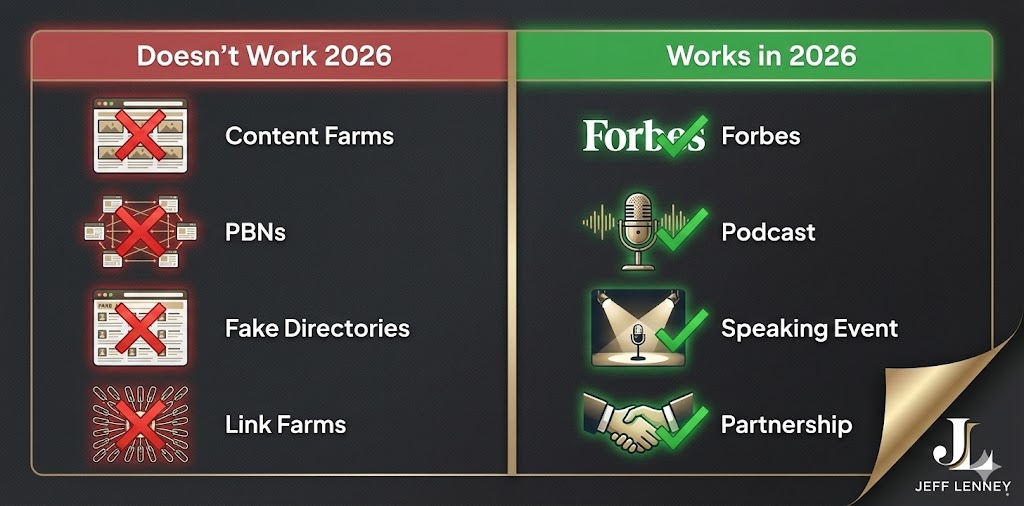
Let me be crystal clear: I still buy backlinks for my clients.
But the strategy has completely changed. It’s not about volume anymore. It’s about entity alignment.
What doesn’t work in 2026:
- Buying guest posts on “high DA” content farms with no real audience
- Paying for link insertions on sites that exist only to sell links
- Directory submissions to sites Google doesn’t recognize as entities
- PBN (Private Blog Network) links from fake sites
- Any link from a site with no employees, no brand, no real business
What DOES work in 2026:
- Links from recognized entities (real brands, real publications, real people)
- Digital PR that gets you mentioned (linked or unlinked) in Tier 1 publications
- Strategic partnerships with other entities in your industry
- High-quality guest posts on sites with actual traffic and brand recognition
- Podcast appearances that result in show notes links from real podcast entities
The difference? Google checks if the linking site is a real entity before counting the link.
That’s why I spend more time vetting link sources now. I don’t just ask “What’s the DA?” I ask:
- “Is this a real brand Google recognizes as an entity?”
- “Do they have actual employees listed on LinkedIn?”
- “Have they been mentioned in the media?”
- “Is their About page written like a real company or like a content farm?”
If the answers are all “no,” the link is worthless. Even if they have a DA of 70.
The Proof: Why Generic Guest Posts Stopped Working
Remember when everyone was buying guest posts on “high DA” sites for $200-500?
Here’s why that stopped working around 2019-2020:
Google checks: “Is the linking site a real entity?”
If it’s a content farm with:
- No real employees listed anywhere
- No mentions in the media
- No presence in Google’s Knowledge Graph
- Just a DA score propped up by buying links themselves
…Google ignores the link. The site isn’t an entity. It’s just a collection of strings Google knows is spam.
This is why Google’s 2022 Link Spam Update destroyed so many “SEO agencies” overnight. They were selling links from non-entities.
The “Brand Mention” Paradox

Here’s the contrarian take that most SEOs refuse to believe:
An unlinked mention on a Tier 1 site is worth more than a dofollow link on a trash site. But a LINKED mention on a Tier 1 site? That’s the holy grail – it’s both a backlink AND entity co-occurrence.
Let me give you a real example.
Scenario A: The “High DA” Guest Post
- SEO consultant paid $400 for a guest post on a “DA65” marketing blog
- Got a dofollow link
- Blog had 200 visitors/month, no real brand, just existed to sell links
- Result: Zero ranking movement
Scenario B: The Podcast Mention (Even Better: With Link)
- Same consultant was interviewed on a marketing podcast with 50K downloads/month
- Host mentioned consultant’s name and expertise 6 times in the episode
- Podcast show notes included a link to consultant’s website
- Result: Rankings jumped for “SEO consultant [city]” within 2 weeks
Why? Because the podcast is a real entity that Google recognizes. The mention created “co-occurrence” – Google saw this consultant’s name mentioned alongside a trusted entity in the marketing/SEO space. And the link? That’s entity-backed link equity – the most powerful kind.
A link from a real entity + a mention = maximum impact. But even just the mention alone beats 10 links from content farms.
That’s Entity Salience at work.
What is Entity Salience?
Entity Salience is how “important” Google thinks your entity is within a topic cluster.
Google measures this by:
- Co-occurrence: Who else mentions your brand? Are they entities Google trusts?
- Context: What topics are you mentioned alongside?
- Consistency: Does your entity info match across the web?
- Recency: Are you still being mentioned, or did your entity die in 2018?
If you’re mentioned alongside Forbes, Zillow, the National Association of Realtors, and major real estate podcasts, Google says: “This is a real person in the real estate entity cluster.”
If you’re only mentioned on your own website and some spammy directories? Google says: “This might not be a real entity.”
How to Build Your “Entity” (The Tactical Guide)
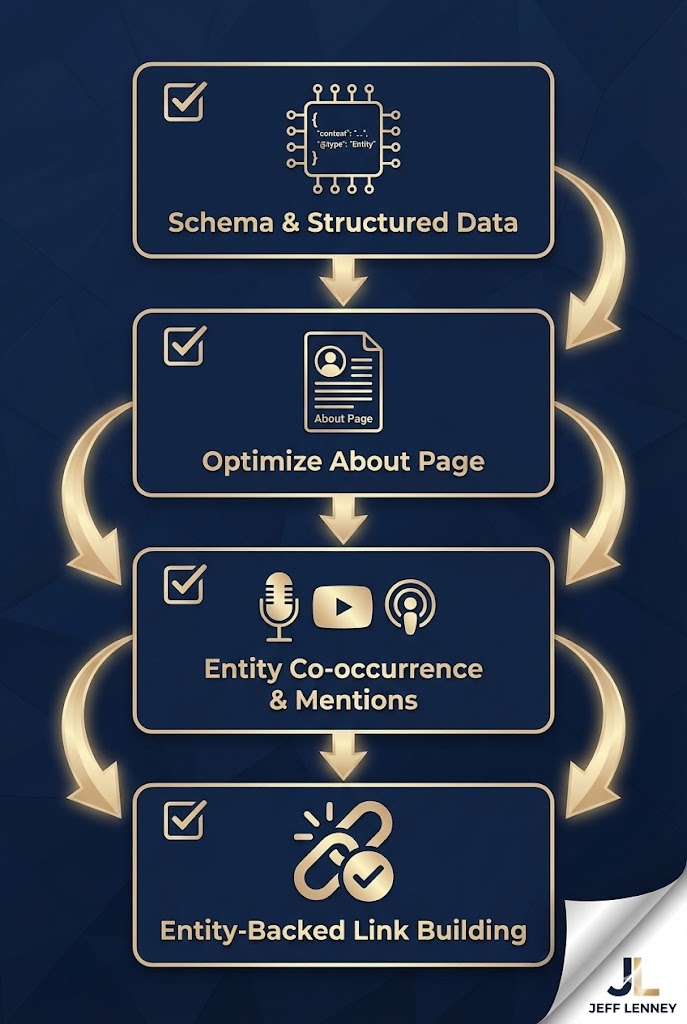
Let’s get tactical. Here’s how to build an entity that Google recognizes and trusts.
1. Schema is Mandatory: Your Digital ID Card
Schema markup is how you tell Google “I am an entity.”
Think of it as your digital ID card. Without it, Google has to guess who you are, what you do, and if you’re even real.
For personal brands (luxury real estate agents, consultants, etc.):
Use Person schema with sameAs properties linking to all your verified profiles:
<script type="application/ld+json">
{
  "@context": "https://schema.org",
  "@type": "Person",
  "name": "John Martinez",
  "jobTitle": "Luxury Real Estate Agent",
  "url": "https://johnmartinezrealestate.com",
  "sameAs": [
    "https://www.linkedin.com/in/johnmartinezrealtor",
    "https://twitter.com/johnmartinezre",
    "https://www.instagram.com/johnmartinezluxury",
    "https://www.zillow.com/profile/johnmartinez"
  ],
  "worksFor": {
    "@type": "Organization",
    "name": "Coastal Luxury Properties"
  },
  "address": {
    "@type": "PostalAddress",
    "addressLocality": "Newport Beach",
    "addressRegion": "CA"
  }
}
</script>
For businesses (brokerages, agencies, SaaS companies, SEO consultancies):
Use Organization schema:
<script type="application/ld+json">
{
  "@context": "https://schema.org",
  "@type": "Organization",
  "name": "Your Company Name",
  "url": "https://yourcompany.com",
  "logo": "https://yourcompany.com/logo.png",
  "sameAs": [
    "https://www.linkedin.com/company/yourcompany",
    "https://twitter.com/yourcompany",
    "https://www.crunchbase.com/organization/yourcompany"
  ],
  "contactPoint": {
    "@type": "ContactPoint",
    "telephone": "+1-555-555-5555",
    "contactType": "Customer Service"
  }
}
</script>
Why sameAs matters:
The sameAs property is the “connector cable” that ties your website to your social profiles, Crunchbase listing, Wikipedia page, etc. It tells Google: “All of these profiles belong to the same entity.”
Without it, Google sees your LinkedIn profile, your Twitter, your website as separate, unconnected things. With it, you’re one cohesive entity.
2. The “About” Page Pivot: Write an Entity Definition, Not a Bio
Most About pages are garbage from an Entity SEO perspective.
Bad About Page (Not Entity-Optimized):
“Hi, I’m John! I love helping families find their dream homes. I’ve been in real estate for 10 years and I’m passionate about making the home-buying process stress-free. In my free time, I enjoy hiking and spending time with my two dogs.”
Cute. Useless for Entity SEO.
Good About Page (Entity-Optimized):
“John Martinez is a licensed luxury real estate agent specializing in Orange County, California, with 12 years of experience in high-net-worth residential sales. He has completed over $150M in transactions, holds the Certified Luxury Home Marketing Specialist (CLHMS) designation, and has been featured in Orange Coast Magazine, Mansion Global, and The Real Deal for his expertise in coastal luxury properties.”
See the difference?
The second version includes:
- Specific credentials (CLHMS)
- Quantifiable achievements ($150M)
- Geographic entity (Orange County, California)
- Industry entity mentions (Orange Coast Magazine, Mansion Global)
This is an Entity Definition Document. It tells Google exactly who you are, what you do, where you do it, and who recognizes you for it.
3. Digital PR: Get Cited by Other Entities
This is where Entity SEO diverges from traditional link building.
Old SEO: “Get links from high DA sites”
New SEO: “Get links from recognized entities”
Notice I didn’t say “get mentions instead of links.” I said get links FROM ENTITIES. The goal is both – entity co-occurrence AND link equity. But if you have to choose between:
- A dofollow link from a DA70 content farm with no brand recognition
- An unlinked mention in Forbes
…take the Forbes mention. Every time.
But the real goal? Get Forbes to link to you. That’s entity co-occurrence + link equity in one shot.
How to do this:
Podcasts: Get interviewed on industry podcasts. Even if they don’t link to you, the mention of your name + expertise builds entity salience.
News mentions: Contribute expert quotes to journalists via HARO (Help a Reporter Out) or similar services. An unlinked quote in Forbes builds more entity trust than 10 paid guest posts.
Industry events: Speak at conferences, webinars, or local events. When the event website lists you as a speaker, that’s entity co-occurrence.
Collaborations: Partner with other recognized entities. Co-host a webinar, co-author a report, cross-promote.
Every time your name appears alongside established entities, Google’s Knowledge Graph gets stronger data that you belong in that cluster.
Before you optimize for entity building, make sure you have content worth citing. That’s where Information Gain comes in – unique insights that make people want to mention you. Then structure it with GEO optimization so AI engines cite you. Finally, distribute it across all platforms using Search Everywhere tactics.
The “Entity Salience” Test

Here’s how to check if you exist as an entity in Google’s Knowledge Graph.
Test 1: Google Your Brand Name + Industry
Search: "Your Name" + "Your Industry"
Example: "John Martinez" + "real estate" or "Jeff Lenney" + "SEO"
What you’re looking for:
- Knowledge Panel on the right side (Google recognizes you as an entity)
- Multiple mentions across different authoritative sites
- Images that are actually you (not random stock photos)
If you don’t have a Knowledge Panel yet, don’t panic. That’s advanced entity status. But you should at least see your website, LinkedIn, and a few mentions.
Test 2: Use Google’s Natural Language API
Google offers a free tool that shows you how it analyzes entities: Google Cloud Natural Language API
Paste your About page or a piece of content into the demo. Look at the “Entity Analysis” results.
What you’re looking for:
- Your name recognized as a “PERSON” entity
- Your business recognized as an “ORGANIZATION” entity
- Your location recognized as a “LOCATION” entity
- High “salience” scores (closer to 1.0 is better)
If Google’s own API doesn’t recognize you as an entity, you’ve got work to do.
Test 3: Check Google Trends
This one’s for more established entities, but it’s worth checking.
Go to Google Trends and search for your brand name.
What you’re looking for:
- Does Google auto-complete your name?
- Is there search volume data?
- Are there “Related queries” that make sense?
If Google Trends says “Not enough data,” you’re not a recognized entity yet. That’s fine – it means you have upside.
Test 4: The Wikipedia Test (Advanced)
This is the gold standard, but it’s hard to achieve unless you’re genuinely notable.
If you have a Wikipedia page that hasn’t been deleted for lack of notability, you’re a verified entity in Google’s eyes. Wikipedia is one of the most trusted sources in the Knowledge Graph.
Important: Don’t create a Wikipedia page for yourself unless you meet their notability guidelines. It’ll get deleted, and that’s worse than not having one.
The Entity SEO Checklist for 2026
Here’s my tactical checklist for building entity authority:
Technical Entity Signals
- ✓ Add Person or Organization schema to your homepage
- ✓ Include sameAs links to all verified social profiles
- ✓ Claim and optimize your Google Business Profile
- ✓ Add Crunchbase profile (even if you’re a solopreneur)
- ✓ Ensure NAP (Name, Address, Phone) consistency everywhere
- ✓ Add LocalBusiness schema if you have a physical location
Content Entity Signals
- ✓ Rewrite About page as Entity Definition Document
- ✓ List specific credentials, certifications, awards
- ✓ Include quantifiable achievements (revenue, transactions, clients)
- ✓ Mention authoritative entities you’ve worked with or been featured in
- ✓ Use exact entity names (don’t say “a major publication,” say “Forbes”)
Off-Site Entity Signals
- ✓ Get mentioned in industry podcasts (linked or unlinked)
- ✓ Contribute expert quotes via HARO or similar services
- ✓ Speak at industry events (webinars, conferences, local meetups)
- ✓ Collaborate with other recognized entities
- ✓ Get featured in local/industry news outlets
- ✓ Build relationships with journalists who cover your space
Social Entity Signals
- ✓ Use consistent branding across all platforms
- ✓ Use the same profile photo everywhere (helps with entity recognition)
- ✓ Link all social profiles back to your website
- ✓ Be active on LinkedIn (Google heavily weighs LinkedIn for professional entities)
- ✓ Engage with other entities in your industry (comments, shares, mentions)
Frequently Asked Questions About Entity SEO

What is Entity SEO?
Entity SEO is the practice of building your brand as a recognized “entity” in Google’s Knowledge Graph rather than just optimizing for keywords and backlinks.
Google’s algorithm has shifted from indexing “strings” (keywords) to indexing “things” (entities) – real people, places, brands, and concepts. Entity SEO focuses on making Google understand who you are, what you do, and how you connect to other trusted entities in your industry.
How is Entity SEO different from traditional SEO?
Traditional SEO focuses on keywords and backlinks. Entity SEO focuses on brand recognition and entity relationships.
Traditional SEO asks: “How many high-DA links can I get?” Entity SEO asks: “Is my brand mentioned alongside trusted entities?” An unlinked mention in the New York Times builds more entity authority than 100 paid guest post links on content farms.
What is Google’s Knowledge Graph?
Google’s Knowledge Graph is a database of entities and their relationships.
Launched in 2012, it maps connections between people, places, brands, concepts, and topics. When you search for a person or brand, the Knowledge Panel that appears on the right side of Google is powered by the Knowledge Graph. If you’re not in the Knowledge Graph, Google doesn’t fully recognize you as a real entity.
What is entity salience and why does it matter?
Entity salience measures how “important” Google considers your entity within a topic cluster.
Google calculates this based on co-occurrence (who mentions you), context (what topics you’re associated with), consistency (is your entity info uniform across the web), and recency (are you still being mentioned). High entity salience = better rankings, even without traditional backlinks.
Do backlinks still matter for Entity SEO?
Yes – backlinks are still critical, but ONLY if they’re from real entities.
One link from a recognized entity (Forbes, NYT, major industry publication, established podcast, real brand) is worth more than 1,000 links from non-entities (content farms, PBNs, low-quality directories). Google checks: “Is the linking site a real entity?” If yes, the link counts. If no, it’s ignored or devalued. Entity SEO makes your backlinks actually work by ensuring you’re getting links from – and becoming – a real entity Google trusts.
How do I add schema markup for Entity SEO?
Use Person schema for personal brands or Organization schema for businesses, with sameAs properties linking to your verified profiles.
Add JSON-LD schema to your homepage including your name, job title, location, and sameAs links to LinkedIn, Twitter, Crunchbase, etc. This acts as your digital ID card, telling Google all these profiles belong to the same entity. Test it with Google’s Rich Results Test tool.
Can small businesses and solopreneurs benefit from Entity SEO?
Absolutely – Entity SEO levels the playing field.
You don’t need a massive budget. You need strategic entity building: claim your Google Business Profile, add proper schema, get featured in local news or podcasts, contribute expert quotes via HARO, and ensure NAP consistency. A local real estate agent with strong entity signals can outrank a national franchise with weak ones.
The Bottom Line: Backlinks + Entity SEO = The Winning Formula
Here’s the hard truth: Link building isn’t dead. Bad link building is dead.
I’ve watched businesses spend $50K+ on “high DA guest posts” from content farms with zero ranking movement. Meanwhile, a single link from a real, trusted entity in their industry moves the needle immediately.
The difference? Entity SEO.
If you’re still buying links from PBNs, content farms, and sites that exist only to sell links – yeah, you’re wasting money. Those sites aren’t entities. Google ignores them.
But if you’re building strategic links from recognized entities while simultaneously building your own entity authority? That’s the winning formula for 2026.
The playbook:
- Build your entity first: Add schema markup, optimize your About page, ensure NAP consistency, claim all profiles
- Get entity co-occurrence: Podcasts, HARO quotes, speaking gigs, collaborations – get mentioned alongside trusted entities
- Pursue entity-backed links: Only invest in links from sites Google recognizes as real entities with real audiences
- Measure entity salience: Use Google’s Natural Language API, check for Knowledge Panel, monitor brand searches
The winners in 2026 have both:
- Strong entity signals (schema, Knowledge Graph presence, entity mentions)
- High-quality backlinks from other recognized entities
It’s not either/or. It’s both.
Start with the technical signals – add Person or Organization schema to your site today. Make sure your sameAs properties connect all your profiles. Rewrite your About page as an Entity Definition Document.
Then focus on the entity building activities that create both co-occurrence AND links: podcasts with backlinks in show notes, HARO quotes that result in linked mentions, speaking opportunities on sites that link to speakers, strategic guest posts on real brands with real audiences.
And remember: you can’t build entity authority around generic content. You need unique insights worth citing, structured with proper GEO formatting, and distributed across all the platforms where your audience searches.
The algorithm doesn’t rank websites anymore. It ranks entities.
But those entities still need backlinks. Just make sure they’re from other entities.
Are you building both?
