
Let me tell you something that’s going to piss off traditional SEOs.
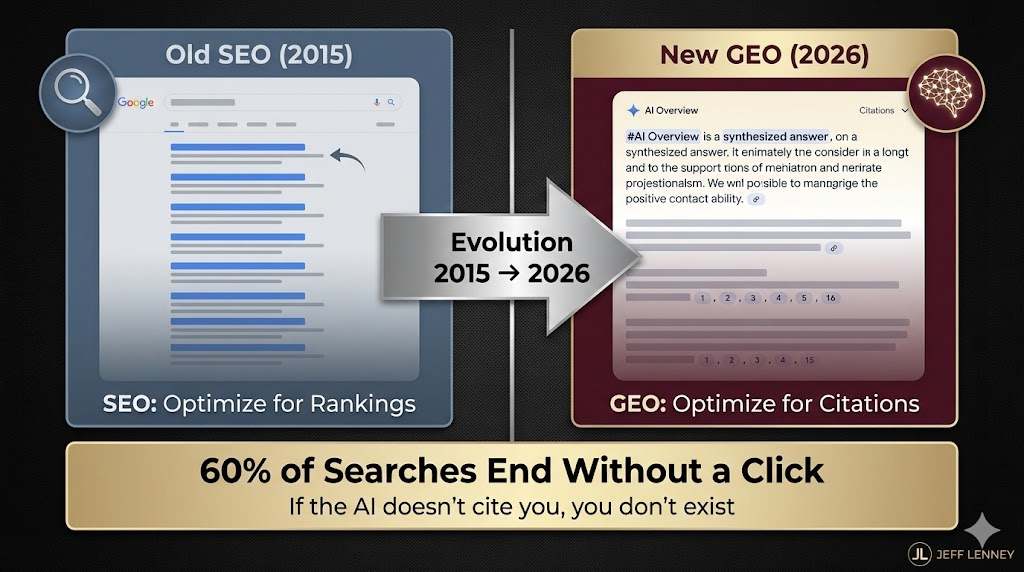
Ranking #1 on Google doesn’t mean sh*t anymore if the AI doesn’t cite you.
I’ve watched clients lose 60% of their organic traffic in the last 18 months despite maintaining their rankings. Why? Because Google AI Overviews are answering the query before anyone clicks. The game changed, and most SEOs are still playing by 2015 rules.
Welcome to 2026, where the goal isn’t ranking – it’s citation. If ChatGPT, Gemini, Perplexity, or Google’s AI Overview doesn’t pull your content into its answer, you’re invisible. You don’t exist.
This is Generative Engine Optimization (GEO), and if you’re not doing it, you’re leaving money on the table.
The Death of the “Blue Link” Monopoly

Here’s the reality check nobody wants to hear: 60% of Google searches now end without a click. That number was 25% just three years ago.
Why? Because AI Overviews answer the question right there in the SERP. The user gets their answer, closes the tab, and you get nothing. Zero traffic. Zero leads. Zero business.
I saw this firsthand with a luxury real estate client in Newport Beach. They ranked #2 for “best gated communities Orange County” – a keyword that used to send them 15-20 qualified leads per month. Then Google rolled out AI Overviews for that query.
Traffic dropped 73% in six weeks.
The AI Overview pulled data from Zillow, Realtor.com, and a few local blogs to synthesize an answer. My client’s site? Not cited. Not mentioned. Might as well have been ranking #47.
This is the new reality: We’re not fighting for rankings anymore. We’re fighting for citations.
If the AI doesn’t cite you as a source, you don’t exist – even if you rank #1 organically.
What is Generative Engine Optimization (GEO)?
Generative Engine Optimization (GEO) is the art of formatting content so Large Language Models (LLMs) prefer it as a source.
Think of it this way:
- SEO optimizes for humans. You write for readability, flow, engagement. You care about bounce rate and time on page.
- GEO optimizes for machines. You structure for retrieval, fact density, and confidence scoring. You care about being scraped correctly.
Traditional SEO asks: “Will a human want to read this?”
GEO asks: “Can an LLM retrieve this cleanly and cite it with confidence?”
The difference is critical. AI doesn’t care about your beautiful prose or your witty analogies. It cares about structure, facts, and certainty.
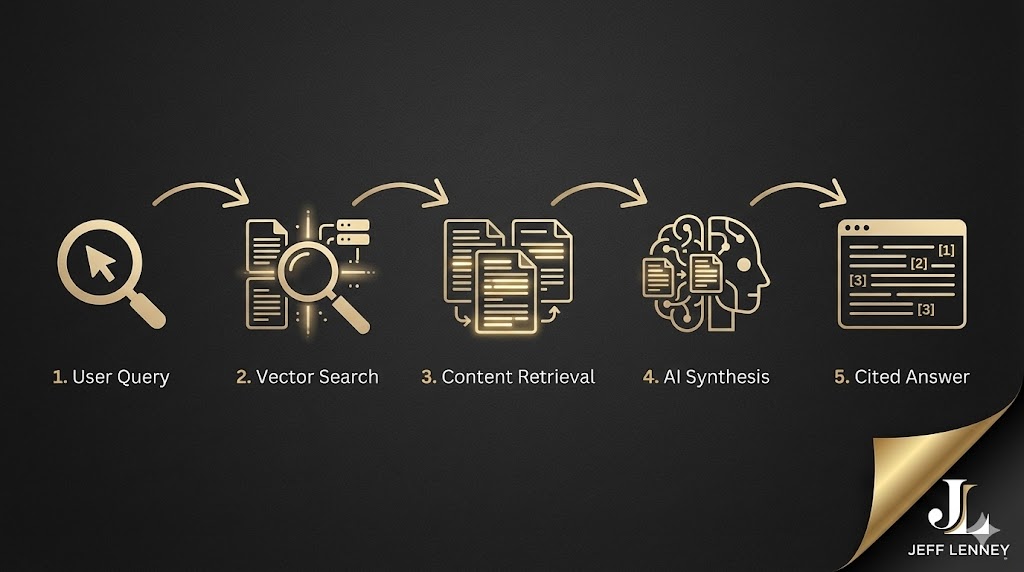
Here’s the technical reality: These AI systems use RAG (Retrieval-Augmented Generation). They don’t store every webpage in their model weights. Instead, they:
- Receive a query from the user
- Search for relevant content chunks (using vector search/embeddings)
- Retrieve the most relevant passages
- Synthesize those chunks into an answer
- Cite the sources they used
To get cited, you need to be retrieved. To be retrieved, your content must match the “embedding” of the question. That means direct, fact-dense answers beat fluffy introductions every single time.
Before you can optimize for AI citations, you need unique information worth citing. That’s where my Information Gain strategy comes in. If you haven’t read that yet, start there. You can’t optimize for AI if you don’t have differentiated content in the first place.
The “Q-Block” Strategy (How to Win)
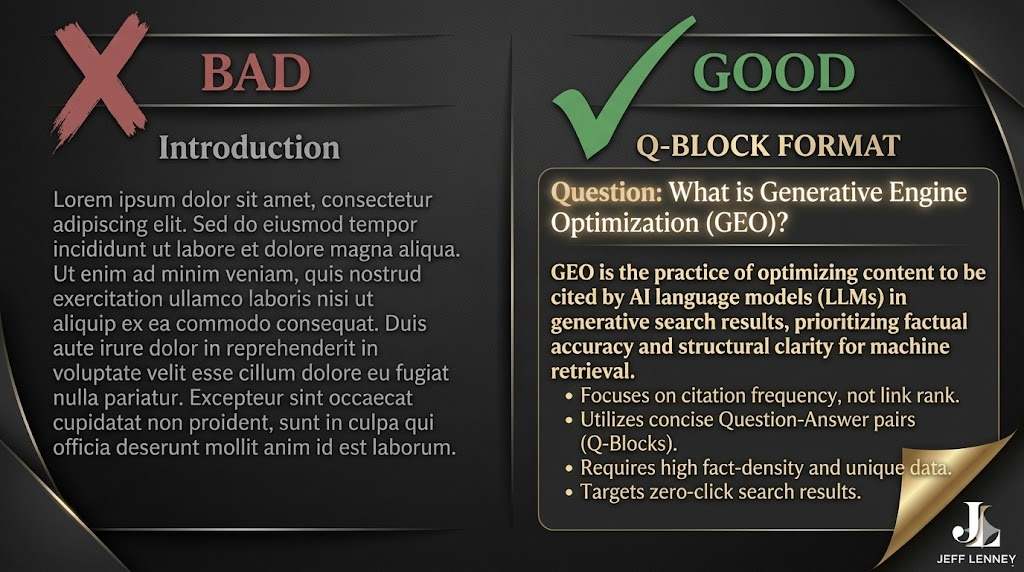
Here’s the tactical framework I use to get my content cited in AI Overviews, ChatGPT responses, and Perplexity answers: Q-Blocks.
A Q-Block is a “Question Block” – a specific structural pattern that LLMs are trained to recognize and retrieve.
The Q-Block Format:
1. The Header: A specific question as your H2 or H3
Example: “What are the best gated communities in Newport Beach?”
2. The Direct Answer: A bolded, definitive response in the first sentence (under 300 characters)
Example: “The top gated communities in Newport Beach are Pelican Hill, Harbor Ridge, Irvine Cove, Big Canyon, and Newport Ridge, with median home prices ranging from $3.2M to $18M+.”
3. The Expansion: Bullet points or a table with supporting data
Example:
- Pelican Hill: $8M-$25M, ocean views, resort-style amenities
- Harbor Ridge: $4M-$12M, harbor views, 24/7 guard-gated
- Irvine Cove: $5M-$18M, private beach access, ultra-exclusive
- Big Canyon: $3.5M-$10M, country club, tennis facilities
- Newport Ridge: $3.2M-$8M, hillside views, family-friendly
Why this works: This mimics the training data LLMs were built on. Wikipedia, Stack Overflow, medical databases – they all use this “question → direct answer → supporting details” structure.
When an AI searches for “best gated communities Newport Beach,” it’s looking for content that matches that exact pattern. Your Q-Block gets retrieved. Your fluffy blog intro with three paragraphs about “the allure of coastal living” does not.
What NOT to Do (The Old SEO Way):
Here’s what most luxury real estate blogs still do:
“When it comes to finding the perfect home in Orange County’s most exclusive neighborhoods, discerning buyers often ask themselves what truly defines luxury coastal living. In today’s competitive real estate market, gated communities offer not just privacy and security, but a lifestyle that speaks to those who demand the very best…”
That’s 50 words of nothing. Zero facts. Zero retrievability. The AI skips right over it.
Compare that to the Q-Block approach:
What are the best gated communities in Newport Beach?
The top gated communities in Newport Beach are Pelican Hill, Harbor Ridge, Irvine Cove, Big Canyon, and Newport Ridge, with median prices from $3.2M to $18M+.
Same information. 30 words instead of 50. But now it’s retrievable. The AI can grab this, cite it, and move on.
That’s the difference between getting cited and getting ignored.
Fact Density & The Luxury Market
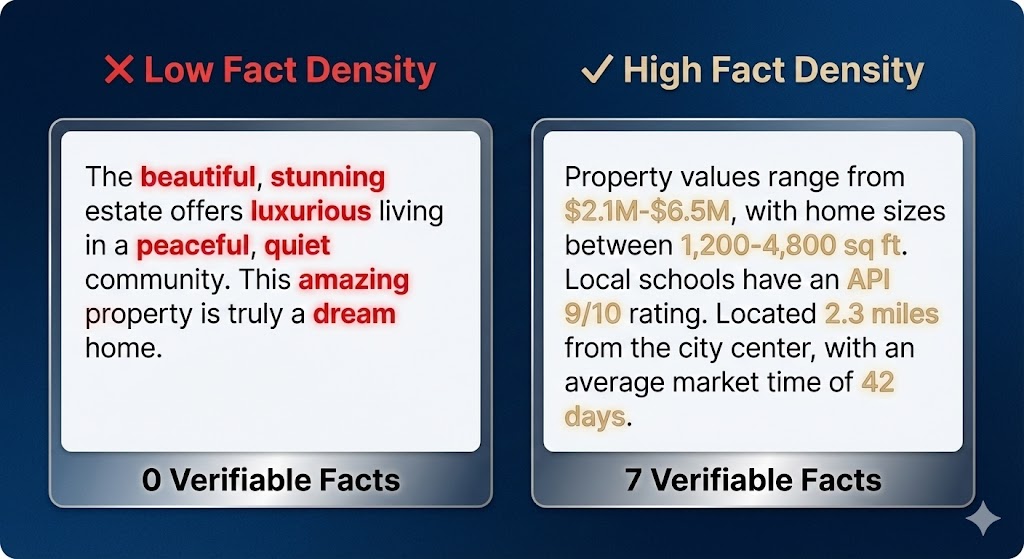
Here’s something most SEOs miss: AI engines measure “Fact Density.”
A paragraph with 5 unique statistics scores higher than a paragraph with 5 adjectives. This isn’t my opinion – this is how RAG systems are designed to work. They’re looking for information that can be verified, cross-referenced, and synthesized.
Low Fact Density (Ignored by AI):
“Turtle Ridge is a beautiful, upscale community known for its stunning views and luxurious amenities. Residents enjoy a peaceful, family-friendly atmosphere with top-rated schools nearby.”
High Fact Density (Retrieved by AI):
“Turtle Ridge homes range from $2.1M to $6.5M, with 1,200-4,800 sq ft floor plans. The community feeds into University High School (API 9/10) and is located 2.3 miles from UCI Medical Center. Average days on market: 42.”
Same community. Second version gets cited. First version gets skipped.
Why? Because the AI can extract verifiable facts: price range, square footage, school rating, distance to amenities, market velocity. These are data points it can use to synthesize an answer.
“Beautiful” and “stunning” are subjective fluff. The AI ignores them.
The “Query Fan-Out” Strategy
Here’s an advanced GEO tactic: Answer the next question before it’s asked.
When someone searches “best neighborhoods in Irvine,” they’re probably going to ask follow-up questions like:
- “What are Irvine schools like?”
- “How much do homes cost in Irvine?”
- “Is Irvine safe?”
- “What’s the commute from Irvine to Newport Beach?”
If your content pre-emptively answers these follow-up queries with Q-Blocks, the AI will cite you for the entire conversation thread – not just the first question.
This is called “Query Fan-Out” and it’s how you dominate an entire topic cluster in AI search rather than just ranking for one keyword.
For luxury real estate agents, this means your neighborhood guides should include Q-Blocks for:
- Price ranges
- School ratings
- Crime statistics
- Commute times to major employment centers
- HOA fees (if applicable)
- Average days on market
- Walkability scores
- Nearby amenities (shopping, dining, beaches)
Each of these becomes a Q-Block. Each Q-Block is a citation opportunity.
My GEO Checklist for 2026
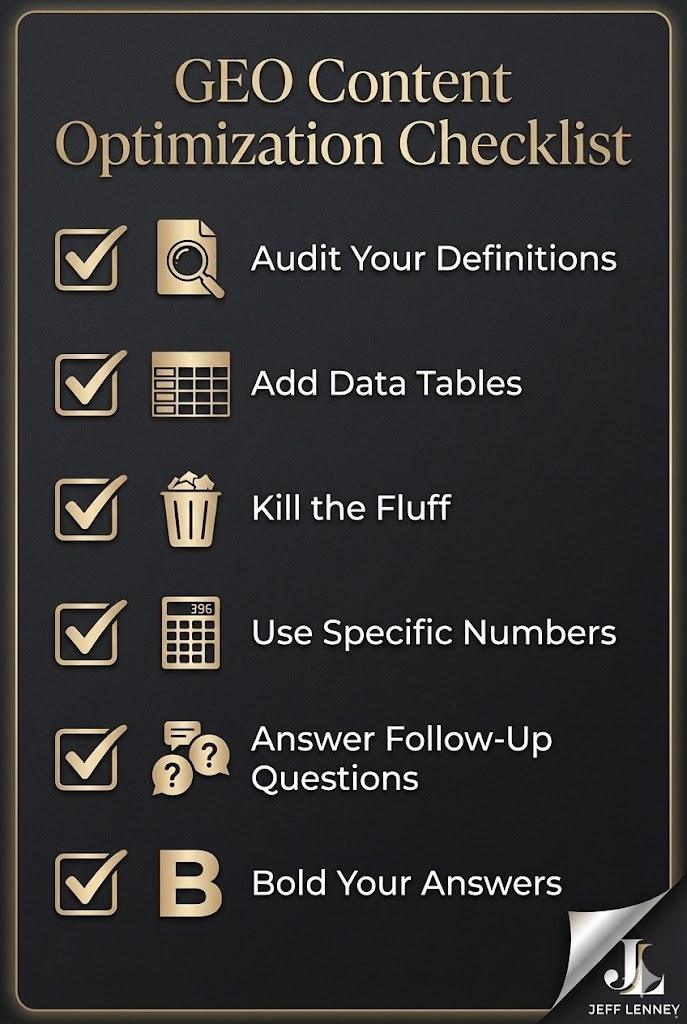
Here’s the tactical audit I run on every piece of content before publishing:
1. Audit Your Definitions
Question: Can an AI extract a clear, factual answer in under 300 characters?
Action: Look at every H2 and H3. If the first sentence isn’t a direct answer, rewrite it.
2. Add Data Tables
Question: Do you have structured data the AI can scrape?
Action: Turn lists into tables. AIs love tables because they’re unambiguous. Example:
| Community | Price Range | Key Feature |
|---|---|---|
| Pelican Hill | $8M-$25M | Resort-style amenities |
| Harbor Ridge | $4M-$12M | Harbor views |
| Irvine Cove | $5M-$18M | Private beach |
3. Kill the Fluff
Question: Does your intro say “In today’s digital landscape…” or “When it comes to…”?
Action: Delete it. Start with the answer. The AI doesn’t need context – it needs facts.
4. Use Specific Numbers
Question: Are you using vague terms like “many” or “most”?
Action: Replace with actual data. “85% of buyers” beats “most buyers.” “$4.2M median” beats “expensive.”
5. Answer Follow-Up Questions
Question: What would someone ask next?
Action: Add Q-Blocks for those queries. This triggers “Query Fan-Out” and gets you cited in longer conversations.
6. Bold Your Answers
Question: Can someone skim your page and extract the answers?
Action: Bold the first sentence of every Q-Block. This signals to both humans and AIs that this is the answer.
GEO vs SEO: The Real Difference
Let me make this crystal clear with a side-by-side comparison:
| Traditional SEO | GEO (2026) |
|---|---|
| Optimizes for human readers | Optimizes for AI retrieval |
| Long, flowing prose | Short, fact-dense answers |
| Keywords in headers | Questions in headers |
| Goal: Get the click | Goal: Get the citation |
| “Comprehensive” = more words | “Comprehensive” = more facts |
| Success metric: Rankings | Success metric: AI mentions |
Both matter. You still need SEO for the 40% of searches that result in clicks. But if you’re ignoring GEO, you’re missing the 60% that don’t.
Frequently Asked Questions About GEO
What is Generative Engine Optimization (GEO)?
Generative Engine Optimization (GEO) is the practice of structuring content so AI systems like ChatGPT, Google AI Overviews, and Perplexity can easily retrieve and cite it.
Unlike traditional SEO which optimizes for human readers and search rankings, GEO optimizes for machine retrieval using techniques like Q-Blocks, high fact density, and structured data.
Is GEO replacing traditional SEO?
No, GEO is complementary to SEO, not a replacement. You need both.
Traditional SEO still matters for the 40% of searches that result in clicks. GEO matters for the 60% of searches that end in AI-generated answers without clicks.
The best strategy is to optimize for both: structure your content for AI retrieval (GEO) while maintaining readability and engagement for human visitors (SEO).
What are Q-Blocks and why do they matter?
Q-Blocks (Question Blocks) are a content structure where you format information as:
- A specific question as a header
- A direct answer in under 300 characters
- Supporting details in bullets or tables
This format mirrors how AI training data is structured, making your content easier for LLMs to retrieve and cite. Q-Blocks dramatically increase your chances of being cited in AI Overviews and chatbot responses.
How do I measure GEO success?
Track AI citations rather than just rankings. Monitor:
- Mentions in ChatGPT responses when your topic is queried
- Citations in Google AI Overviews
- References in Perplexity answers
- Traffic from AI Overview click-throughs
You can also use tools that track “zero-click” search impressions and monitor whether your content appears in featured snippets, which often feed AI systems.
Does GEO work for local businesses and real estate?
Absolutely. GEO is especially powerful for local businesses and real estate because AI searches for these topics prioritize factual, location-specific information.
When someone asks “best neighborhoods in Orange County” or “luxury homes in Newport Beach,” AI systems retrieve and cite content with specific data: price ranges, school ratings, amenities, commute times.
Q-Blocks with local data points perform exceptionally well in AI search results. (This is especially critical for luxury real estate agents competing in high-value markets.)
Can I use AI to write GEO-optimized content?
Yes, but with a critical caveat: AI can help with structure and formatting, but you still need unique information.
You can’t just have ChatGPT write generic content about neighborhoods – that’s what everyone else is doing. Use AI to format your proprietary insights, market data, and local expertise into Q-Blocks.
The Information Gain principle still applies: differentiated content gets cited, generic content gets ignored.
What’s the difference between fact density and keyword density?
Keyword density measures how often you repeat specific words (an outdated SEO metric). Fact density measures how many verifiable data points you include per paragraph.
For GEO, fact density matters more. Examples:
- High fact density: “Median price $4.2M, average 3,200 sq ft, built 2015-2020, HOA $450/month”
- Zero fact density: “Beautiful, luxurious, stunning, prestigious”
The first example gets cited. The second gets ignored.
The Bottom Line: Adapt or Disappear
Here’s the hard truth: The 10 blue links are dying. AI Overviews are here to stay. And if you’re still optimizing like it’s 2015, you’re going to watch your traffic evaporate while wondering what happened.
I’ve seen it happen to clients who refused to adapt. They kept ranking. They kept showing up on page one. But their traffic dropped 50-70% because the AI was answering the query without sending clicks.
The winners in 2026 are the ones who get cited, not just ranked.
GEO isn’t some theoretical future strategy. It’s happening right now. Google AI Overviews are live. ChatGPT is citing sources. Perplexity is growing like crazy. Every day you wait is traffic you’re losing to competitors who figured this out six months ago.
Start with the Q-Block strategy. Audit one piece of content this week. Turn your fluffy intros into direct answers. Add data tables. Answer the follow-up questions.
And remember: you can’t optimize for AI if you don’t have information worth citing in the first place.
The algorithm doesn’t reward effort. It rewards facts. It rewards structure. It rewards differentiation.
That’s how you win in 2026.
