
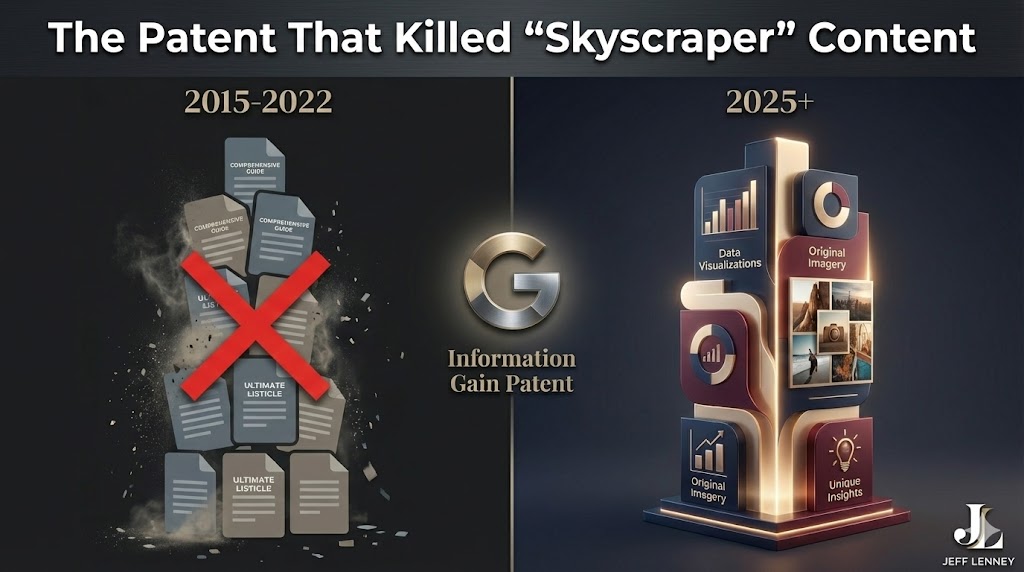
Let me tell you something that’s going to piss off a lot of SEOs.
All those “comprehensive guides” you spent weeks writing? The ones where you analyzed the top 10, merged their talking points, added 500 more words, and called it a day? Google doesn’t care anymore.
They’re actively demoting that garbage.
In June 2022, Google was granted patent US11354342B2. The title? “Contextual Estimation of Link Information Gain.” While everyone was freaking out over Core Web Vitals and arguing about link velocity, this patent quietly redefined what it means to rank in 2025 and 2026.
Here’s the concept: Google now calculates how much new information a user gains from your page after they’ve already seen other results.
If your content is just a remix of what’s already ranking, your Information Gain score tanks. And when that score tanks, so does your traffic.
This isn’t theory. This is documented, patented math that Google is using right now to decide whether your content deserves to exist in the SERPs.
What Exactly Is Information Gain?

Let me break down the patent without getting lost in the legalese.
Google’s Information Gain system works like this:
When a user searches for “best protein powder for weight loss,” Google doesn’t just look at your page in isolation. It evaluates your content in the context of what else is already ranking for that query.
The algorithm asks: “If someone already read pages 1 through 5, what new information does page 6 provide?”
If the answer is “not much,” you get scored down. If you’re bringing genuinely new data, perspectives, or insights to the table, you get boosted.
Think of it like this: You’re at a dinner party where five people have already told the same story about their trip to Italy. When you stand up to share your Italy story, nobody cares unless you’ve got something different to say. Maybe you got food poisoning from street pizza. Maybe you found a hidden wine bar that’s not in any guidebook. That difference is what matters.
Google is applying this same logic to search results.
The patent specifically mentions that the system:
- Analyzes the “information content” of documents already presented to users
- Calculates the incremental information value of new documents
- Adjusts rankings based on how much additional value each result provides
- Penalizes content that’s redundant with higher-ranking results
Translation: If you’re regurgitating the same talking points as everyone else, you’re done.
The Death of the Skyscraper Technique

Brian Dean popularized the Skyscraper Technique back in 2013, and for years, it worked like gangbusters.
The formula was simple:
- Find content that’s ranking well
- Make something “better” (longer, more detailed, more images)
- Promote the hell out of it
- Watch the rankings roll in
Here’s the problem: Everyone started doing it.
By 2020, searching for anything remotely competitive meant wading through ten 5,000-word “ultimate guides” that all said the exact same things in slightly different orders. Same screenshots (usually from the same tools), same definitions, same generic advice.
Google’s response? The Information Gain patent.
Now, being “more comprehensive” isn’t enough. In fact, it can actively hurt you if your “comprehensiveness” just means you’re covering the same ground as everyone else in more words.
I see this constantly with my real estate agent clients. They’ll hire some content mill to write a “Complete Guide to Selling Your Luxury Home in Orange County,” and it reads exactly like every other luxury real estate guide on the planet. Same sections. Same advice. Same stock photos of staging and open houses.
Zero information gain.
And then they wonder why it doesn’t rank, or worse, why it ranks for a month and then disappears after the next core update.
The Skyscraper Technique didn’t die because it was bad. It died because it became the default, and Google had to evolve past it.
How to Actually Create Information Gain

Alright, enough doom and gloom. Here’s how to win under this new reality.
Creating Information Gain isn’t rocket science. It just requires you to think differently about content creation.
Look, I still use tools. I use them to find the ‘Topical Gaps.’ But while most SEOs stop there, I use that as my starting line. I see the gap, and then I fill it with a story from my 15 years of experience, not just a rewritten paragraph from Wikipedia.
Here are the tactics that actually work:
Proprietary Data Is Your Nuclear Weapon
Nothing screams “information gain” louder than data that literally cannot exist anywhere else.
This means:
- Your own case studies with actual numbers
- Screenshots from your own campaigns (not stock images)
- Failed experiments and what you learned from them
- Customer data (anonymized, obviously)
- Before/after results from your actual work
When I write about SEO for real estate agents, I don’t pull generic statistics about “organic traffic increases.” I show screenshots of Google Search Console data from actual clients, with specific keywords and traffic numbers. I show the exact pages that moved from position 15 to position 3, and I explain why.
That’s information Google’s crawlers can’t find anywhere else.
And here’s the kicker: your failures are often more valuable than your successes. Everyone talks about what worked. Almost nobody documents what bombed and why. That’s a massive opportunity.
Did you spend $5,000 on a link building strategy that did absolutely nothing? Write about it. Show the data. Explain what you’d do differently. That’s Information Gain gold.
The Anti-Pick Strategy
This one’s counterintuitive, but it works.
Most content in every niche is promotional. “Best X for Y” posts are really just “buy this stuff we’re affiliates for” in disguise. Users know this. Google knows this.
So flip the script.
Tell people what NOT to buy. Explain what doesn’t work. Call out the garbage products that everyone else is recommending.
I do this constantly on my archery website. Instead of just listing “best beginner bows,” I’ll dedicate entire sections to “Bows Beginners Should Avoid (Even Though They’re Popular).” I’ll explain exactly why certain highly-rated products on Amazon are actually terrible choices, and back it up with specifics.
This does two things:
- It creates massive trust because you’re clearly not just shilling for affiliate commissions
- It provides information that’s genuinely hard to find elsewhere (negative reviews get buried, and most content creators won’t risk pissing off manufacturers)
The Anti-Pick is one of the highest Information Gain plays you can make because it’s information that actively contradicts what’s already ranking.
Cross-Niche Logic
Most SEOs stay in their lane. Real estate people read real estate content. Fitness people read fitness content. Everyone stays in their little bubble.
That’s a mistake.
Some of my best content ideas come from applying concepts from completely different industries to my niche.
For example, I took the concept of “loss aversion” from behavioral economics and applied it to real estate SEO content. Instead of writing another generic “how to increase your home’s value” post, I wrote a similar post to “The 7 Curb Appeal Mistakes That Are Costing You $50K+ in Your Home Sale” for a client.
Same topic. Totally different angle. Way more engagement. Better rankings.
Why? Because nobody else in real estate SEO was framing it that way. The loss aversion angle was common in finance content but rare in real estate. That’s a clear information difference.
Look outside your niche for frameworks, mental models, and approaches that your competitors aren’t using. Then translate them into your world.
Real SME Quotes (Not BS)
AI can write convincingly about almost anything now. But you know what it can’t do? Interview an actual human expert and quote them.
This is becoming increasingly valuable as more content becomes AI-generated. Real quotes from real people with real expertise are a clear signal that your content has human input that can’t be replicated by scraping and synthesizing existing content.
But here’s the catch: the quotes need to be substantive.
Don’t just reach out to some “industry expert” and get a bland soundbite like “SEO is constantly evolving, so it’s important to stay up to date.” That’s worthless.
You want insights that change how someone thinks. You want the expert to disagree with conventional wisdom or explain something in a way that clicks differently than the standard explanation.
I’ve started doing this more on JeffLenney.com. Instead of just writing “here’s what I think about X,” I’ll reach out to specific people I know who have deep experience in narrow areas and get their take. Then I’ll weave that into the content, cited and quoted.
It adds authenticity, it adds information that’s literally not available elsewhere, and it signals to Google that this isn’t regurgitated AI slop.
The E-E-A-T Connection

Here’s something most SEOs are missing.
When Google rolled out the extra E in E-E-A-T (making it “Experience, Expertise, Authoritativeness, and Trustworthiness”), most SEOs treated it like a checklist. Add an author bio. Get some credentials. Link to authoritative sources. Done.
But Information Gain is the mathematical implementation of Experience.
Think about it: How does Google algorithmically determine if you have real experience? By checking if your content contains information that couldn’t exist without that experience.
If you’re writing about “how to train for a marathon” and your content is indistinguishable from the other 50 generic marathon training guides, Google has no signal that you’ve actually run a marathon. You’re just synthesizing what you read elsewhere.
But if your content includes:
- Your actual training logs with specific pace data
- Photos from your race with your bib number visible
- Specific insights about the mental challenge at mile 18 that you learned from experience
- A story about the time you bonked because you tried a new gel on race day
Now Google has signals that you’ve lived this. The Information Gain score goes up because that content couldn’t have been created by someone who just read about marathons online.
E-E-A-T without Information Gain is just theater. Information Gain is how Google actually measures whether your “experience” is real or fabricated.
The 5-Step Information Gain Audit
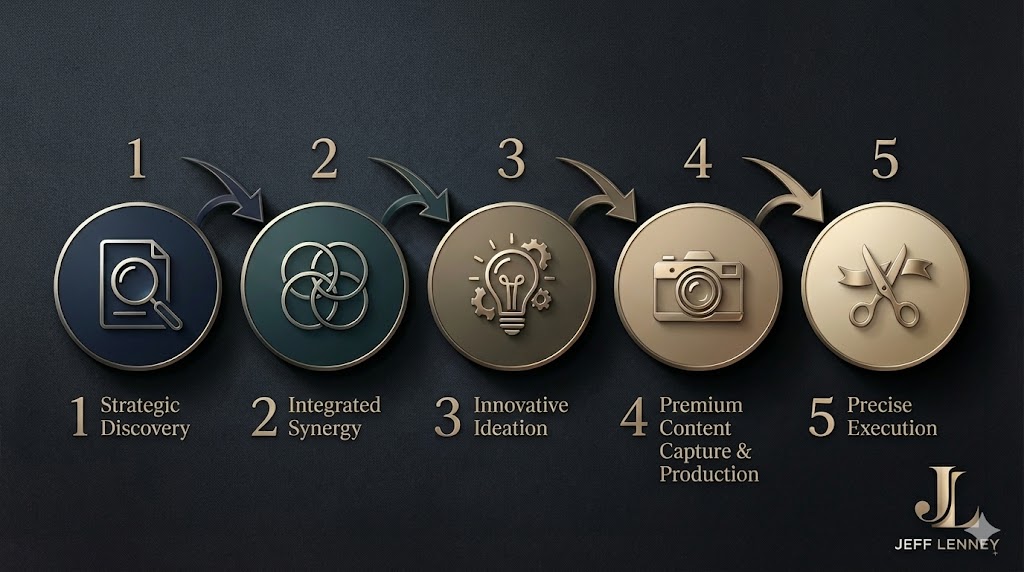
Let me make this tactical. Here’s how to audit your existing content and boost its Information Gain score:
Step 1: Search Your Target Keyword and Read the Top 5 Results
Actually read them. Take notes on what they cover. What examples do they use? What data do they cite? What’s the general perspective?
Step 2: Identify the Consensus
What are all five results saying that’s essentially the same? These are the table stakes topics you need to cover, but they provide zero differentiation.
Step 3: Find What Makes You Different
Ask yourself: “What do I know about this topic that these five pages don’t mention?” This could be:
- A personal experience
- Data from your own business
- A contrarian opinion you can back up
- A connection to another concept that isn’t obvious
- A mistake everyone makes that nobody talks about
Step 4: Add Unique Assets
Go through your content and add at least three pieces of media or data that cannot exist anywhere else: your own screenshots, your own photos, your own charts based on your own data.
Generic stock photos and charts from Statista don’t count.
Step 5: Cut the Redundant Fluff
This is the hard part. Look at your content and ask, “If someone has already read the top-ranking pages, would this paragraph tell them anything new?”
If the answer is no, cut it or rewrite it.
Being shorter but more unique beats being longer and more redundant.
The Bottom Line

The SEO game has changed, and most people are still playing by 2015 rules.
Google’s Information Gain patent isn’t some theoretical future tech. It’s live. It’s impacting rankings right now. And if you’re still building content by copying what’s ranking and trying to make it “better” through comprehensiveness, you’re wasting your time.
The algorithm doesn’t reward effort. It rewards what’s new and different.
Your content needs to provide information that’s genuinely new, either through proprietary data, unique perspectives, or insights that require real-world experience to obtain.
- The good news? This actually makes SEO more interesting. Instead of being a glorified content assembly line, you actually have to think, create, and bring something real to the table.
- The bad news? It’s harder. You can’t outsource this to a content mill. You can’t automate it with AI alone. You need to actually know your sh*t and be willing to share insights that have value.
But if you lean into Information Gain, you’ll have a massive advantage over the 90% of SEOs who are still trying to win by writing more words and stuffing in more keywords.
Stop trying to be comprehensive. Start trying to be different.
That’s how you win in 2026.
Frequently Asked Questions
Q: Does Google officially confirm they use the Information Gain patent in their ranking algorithm?
A: Google doesn’t explicitly confirm which specific patents are active in their core algorithm (they never do). However, the patent was granted in 2022, and the ranking behavior we’re seeing aligns perfectly with what the patent describes. Multiple analyses from SEO experts show that content with unique data points and perspectives is outranking more “comprehensive” but redundant content. The correlation is strong enough that ignoring it would be stupid.
Q: Can AI tools like ChatGPT create content with high Information Gain?
A: Not by themselves. AI tools are trained on existing content, which means they’re fundamentally synthesizing what already exists. They can’t create genuinely new data, real case studies, or unique experiences. However, you can use AI to help structure and write content that incorporates your unique insights. Think of AI as the writer and yourself as the source of the actual information gain.
Q: How do I create Information Gain in a saturated niche where everything’s been written about?
A: This is where proprietary data becomes non-negotiable. Even in ultra-competitive niches, your specific results, your specific failures, and your specific processes are unique. If you’re in affiliate marketing, document your actual campaigns. If you’re in fitness, share your clients’ real transformations (with permission). The niche being saturated just means generic content won’t work, you need to go deeper into specifics that only you can provide.
Q: Does this mean I should make my content shorter?
A: Not necessarily shorter, but more focused on what’s actually new. If you have 3,000 words of genuinely unique insights, that’s great. If you have 500 words of unique insights padded with 2,500 words of generic background information everyone else already covers, cut the padding. Length for length’s sake is dead. Unique value density is what matters.
Q: How long does it take to see ranking improvements after adding Information Gain to existing content?
A: Depends on your site’s crawl frequency and authority, but typically you’ll see movement within 2-4 weeks if the changes are substantial. For new content, it can take 2-3 months to fully stabilize. The key is that Information Gain isn’t a quick fix, it’s about fundamentally changing how you approach content creation. Sites that consistently publish high-Information-Gain content tend to see compounding benefits over 6-12 months.
