

Most real estate agents treat Google Local Services Ads and SEO like competing strategies.
Wrong approach.
LSAs and SEO work better together. LSAs capture “realtor near me” searches immediately. SEO captures research queries LSAs can’t touch and builds long-term assets that reduce your LSA dependency.
I’ve been doing SEO for 15+ years. The highest-producing agents run LSAs for immediate leads while building SEO that eventually dominates their lead generation.
This is the tactical framework for combining both channels – when to use each, budget allocation, and the transition from paid-dependent to organic-dominant.
📊 Key Takeaways
- Different Search Intent – LSAs capture “realtor near me” (ready now). SEO captures “living in [neighborhood]” (6-12 months out). Both needed for complete market coverage
- Lead Cost Varies 10x – Small markets: $15-40/lead. Competitive markets: $80-200/lead. Track cost per closed deal, not cost per lead
- Budget Evolution – Year 1: 35-40% LSAs, 60-65% SEO. Year 2: 25-30% LSAs, 70-75% SEO. Year 3+: 15-20% LSAs, 80-85% SEO as organic matures
- Conversion Quality Difference – LSA leads: 3-8% conversion. Organic leads: 8-15% conversion. Higher quality comes from research time
- LSAs Build Zero Equity – Stop paying, leads stop. SEO builds assets generating leads years after publication
Google Local Services Ads:
– Pay $15-200 per lead
– Top search placement
– Geographic targeting only
– Immediate results
– Zero long-term value
Organic SEO (tiered approach):
– DIY: $0 but requires your time investment
– Budget agencies: $2K-5K/month (basic content only)
– Comprehensive strategy: $6K-12K+/month (professional content, technical optimization, strategic backlinks)
– Timeline: 6-12 months to meaningful results regardless of tier
– Long-term value: Builds compounding assets
The comprehensive approach I outline in my real estate SEO guide, neighborhood strategy, and luxury marketing guide requires a higher investment but builds assets that generate leads for years.
Note on video: My SEO packages optimize and rank videos you produce (titles, descriptions, YouTube strategy, schema, embedding) – but video production/filming is handled by your videographer. See my video SEO guide for the optimization framework.
When to Use LSAs vs SEO
Use LSAs when:
– You need leads this month
– Lead costs are under $100 in your market
– You convert at 5%+
– You respond within 5 minutes consistently
Skip LSAs when:
– Leads cost $150-200+ (ROI breaks down)
– You can’t answer calls immediately
– You convert under 3%
– You already rank organically for “realtor [city]”
Always invest in SEO when:
– You have 12+ month timeline
– You want to build an asset vs rent leads
– You’re targeting research-phase buyers
– You want 8-15% conversion vs 3-8%
The Three-Year Strategic Plan

Year One: LSA-Heavy Foundation Building
Total budget: $8,500-13,000/month
Budget split: 35-40% LSAs ($3,000-5,000/month), 60-65% SEO ($6,000-8,000/month)
LSA strategy: Run LSAs for immediate cash flow. Test geographic targeting, track conversion rates, optimize response time.
SEO priorities (comprehensive approach):
1. Publish 15-20 comprehensive neighborhood guides (professional content, not thin articles)
2. Optimize Google Business Profile completely
3. Set up proper analytics and call tracking
4. Build 20-30 strategic backlinks from relevant sources
Expected results: LSAs generate 15-25 leads monthly. SEO generates 0-2 leads monthly. That’s expected – you’re building assets that compound over time.
Note: Budget agencies charging $2K-5K/month won’t deliver this level of depth. The comprehensive strategy I outline in my neighborhood SEO guide requires significant investment but builds real authority.
Year Two: Balanced Transition
Total budget: $8,500-14,000/month
Budget split: 25-30% LSAs ($2,500-4,000/month), 70-75% SEO ($6,000-10,000/month)
LSA strategy: Reduce LSA budget 20-30%. Focus on seller-intent keywords only. Pause low-converting time slots and geographic areas.
SEO priorities:
1. Publish 20+ additional neighborhood guides
2. Create comparison content
3. Build 30-50 premium backlinks
4. Add video content for key neighborhoods
Expected results: LSAs generate 12-18 leads monthly. SEO generates 5-10 leads monthly (growing 30% monthly). Total lead volume stays stable while blended cost per lead decreases.
For backlink tactics, see my backlink building guide.
Year Three+: Organic Dominance
Total budget: $7,500-12,500/month
Budget split: 15-20% LSAs ($1,500-2,500/month), 80-85% SEO ($6,000-10,000/month)
LSA strategy: Run LSAs strategically only – “sell my house [zip]” in target neighborhoods. Pause generic “realtor near me” since you rank organically.
SEO priorities:
1. Maintain publishing (2-4 articles monthly)
2. Refresh top content annually
3. Build premium backlinks from industry publications
4. Expand to adjacent markets
Expected results: SEO generates 30-50 leads monthly. LSAs supplement with 5-10 high-intent seller leads. Organic is now primary lead source.
For video optimization, see my video SEO guide.
Budget Allocation Framework

Calculate your LSA economics:
LSA cost per lead ÷ Conversion rate = Cost per deal
Example: $100 per lead, 5% conversion = $2,000 per closed deal. On $15K commission, that’s 13% CAC – acceptable.
If cost per deal exceeds 30% of commission, shift budget to SEO.
Track blended performance:
– LSA leads and cost
– Organic leads and investment
– Conversion rate by source
– Cost per closed deal by source
For complete analytics setup, see my analytics guide.
Decision matrix:
– Need leads now, cash-flow tight: 70% LSAs, 30% SEO
– Profitable, building: 50% LSAs, 50% SEO
– Established, 6-12 month runway: 30% LSAs, 70% SEO
– $10M+ volume, patient: 20% LSAs, 80% SEO
– Already ranking well: 10% LSAs (strategic), 90% SEO
LSA Optimization Essentials
Geographic Targeting
Default LSA radius is 25-50 miles. Tighten to 10-15 miles around your target market. Don’t pay for leads in areas you don’t serve.
Dispute Invalid Leads
Dispute within 30 days:
– Spam/robocalls
– Wrong service category
– Outside service area
– Duplicates
– No contact info
Google refunds 30-60% of disputed leads. This saves $500-2,000 monthly in competitive markets.
The Refund Script (Exact Verbiage That Works)
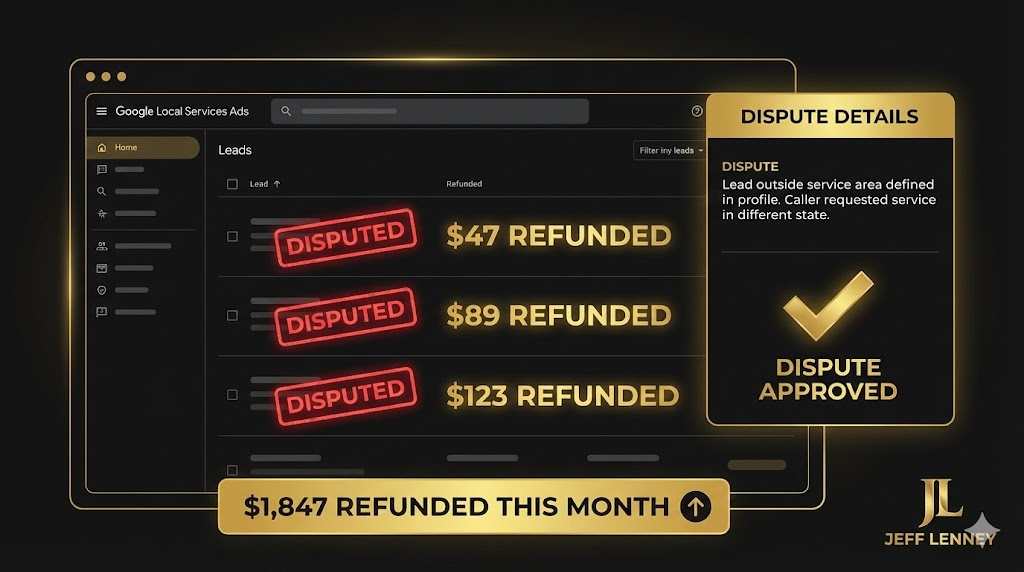
Most agents don’t dispute bad leads because they don’t know what to say. Google’s dispute system is vague on purpose – they want you to give up.
Here’s the exact language that gets refunds approved at 70%+ rate:
For spam/robocalls:
For wrong service area:
For wrong service type:
For duplicate leads:
For no contact info provided:
Pro tips for higher dispute approval rates:
- Dispute within 24-48 hours. Google approves recent disputes faster than month-old claims.
- Be specific with times and details. “Robocall at 2:47 PM, hung up after 3 seconds” beats “Got a spam call.”
- Reference LSA policies. Google’s own terms say leads must be relevant and actionable. Quote this.
- Keep it under 200 characters. Shorter disputes process faster – Google’s reviewing thousands daily.
- Don’t be emotional or accusatory. “This is ridiculous, you’re ripping me off” gets denied. Stay factual.
Track your dispute win rate:
Create a spreadsheet:
- Date of lead
- Reason for dispute
- Exact verbiage used
- Approved/Denied
- Refund amount
If your approval rate is under 50%, you’re not being specific enough. If it’s over 80%, you’re leaving money on the table by not disputing marginal leads.
Real-world impact:
Agent in Newport Beach was paying $150/lead. Wasn’t disputing anything. Started using these scripts religiously – disputed 12-15 leads monthly, got $1,800-2,200 back every month. That’s $21,600 annually.
Same lead quality. Same volume. Just stopped accepting invalid charges.
Dispute aggressively. Google built this into their business model – they expect disputes. Don’t feel bad about it.
Response Speed
Respond within 5 minutes or lose the lead. LSA buyers contact 5+ agents – first responder wins.
Create message templates for instant responses. Set up call forwarding to mobile.
The Booking Slot Strategy (Stop Wasting Money on Tire-Kickers)
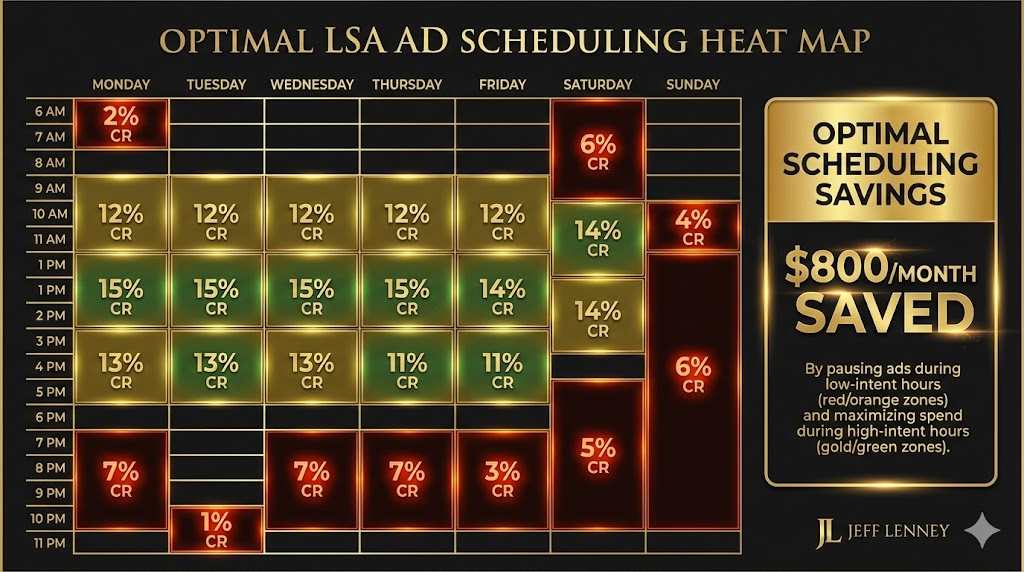
Here’s a tactic almost nobody uses: turning off LSAs during low-intent hours.
Most agents run LSAs 24/7. That’s burning money.
Sunday morning at 9 AM? Tire-kickers browsing Zillow with coffee. Tuesday at 11 PM? People who won’t respond to follow-up.
The data on lead quality by time slot:
Why time of day matters:
Think about when YOU seriously research major purchases versus when you casually browse.
Patterns most agents see with LSA leads:
Higher-intent time slots (worth testing):
- Weekday business hours (9 AM – 6 PM) – people researching during lunch breaks or work-from-home time
- Weekday evenings (6-8 PM) – couples researching together after work
- Saturday midday (10 AM – 4 PM) – planned weekend house hunting research
Lower-intent time slots (potentially worth pausing):
- Sunday mornings – casual Zillow browsing with coffee
- Late nights after 9 PM – impulse browsing, less likely to follow through
- Friday evenings – weekend mode, not serious research mode
But your market might be completely different. The only way to know is tracking your own data for 60-90 days.
Why the difference?
Serious buyers contact you during work hours or planned weekend search time. Casual browsers contact you when they’re bored or procrastinating.
Late-night leads ghost. Sunday morning leads “just looking.” Friday night leads are drunk (not joking – this actually happens).
How to set up ad scheduling in LSA:
Google Local Services doesn’t have built-in ad scheduling like Google Ads does. But you can manually control it:
Option 1: Pause/unpause manually
- Open LSA dashboard on mobile
- Tap “Pause leads” before low-intent time slots
- Set phone reminder to unpause during high-intent hours
This is annoying but free. Takes 30 seconds twice daily.
Option 2: Use a virtual assistant
- Hire VA for $5-8/hour
- Give them access to pause/unpause LSAs on schedule
- Costs $200-300/month
- Saves $500-1,000/month in wasted leads
Option 3: Adjust phone forwarding (stealth method)
- Set up Google Voice as your LSA number
- Forward to mobile during high-intent hours only
- Forward to voicemail during low-intent hours
- You still get charged, but you screen leads passively
Not ideal (you pay for leads you ignore), but better than answering garbage calls.
The math on this:
Agent paying $100/lead, getting 25 leads/month.
8 of those leads (32%) come during low-intent time slots. Conversion rate: 2%
17 leads (68%) come during high-intent slots. Conversion rate: 12%
Without time slot optimization:
– Total spend: $2,500/month
– Closed deals: 2.4/month (0.16 from low-intent + 2.04 from high-intent)
– Cost per deal: $1,042
With time slot optimization (pause low-intent hours):
– Total spend: $1,700/month (17 leads at $100 each)
– Closed deals: 2.04/month
– Cost per deal: $833
Same outcome. $800/month savings. $9,600 annually.
Test your own data first:
Don’t just copy my time slots. Your market might be different.
Track 60-90 days:
- Day/time of lead
- Response/follow-up behavior
- Converted? Y/N
Find your low-intent patterns. Pause those time slots. Reallocate budget to high-intent hours.
When NOT to use this strategy:
- You’re getting under 15 leads/month (sample size too small)
- Your market has few competing agents (you need coverage to block competition)
- You convert at 15%+ across all time slots (you’re an outlier, don’t fix what works)
But if you’re in a competitive market paying $80-200/lead and converting at 5-8%, this tactic alone can save you $6K-12K annually.
For more advanced LSA strategies, check out the Google Local Services Help Center and WordStream’s LSA optimization guide.
Common Mistakes to Avoid

Choosing One Over the Other
“LSAs only” = $50K-150K annually with zero equity built. “SEO only” = 12-18 months with no leads while building.
Run both. LSAs fund your business while SEO builds assets.
Not Tracking Source-Level ROI
LSA leads and organic leads convert at different rates and costs. Track separately in your CRM.
You can’t optimize what you don’t measure.
Running LSAs Without Conversion Systems
Paying $3,000/month for LSAs but not answering calls or responding to messages = flushing money.
Fix conversion before scaling LSAs:
– Auto-responder for messages
– Call forwarding to mobile
– Follow-up cadence (6+ touches first week)
– CRM tracking
Pausing LSAs Too Early
500 monthly organic visits ≠ 25 leads. You need 1,000-2,000 monthly visitors to replace LSA lead volume.
Reduce LSAs gradually: 40% → 30% → 20% → 10% over 18-24 months.
Ignoring Google Business Profile
Your GBP affects LSA rankings AND local pack rankings. Poor GBP = pay more for LSAs AND rank lower organically.
Complete profile, get 50+ reviews, post weekly. For complete GBP strategy, see my GBP optimization guide.
Why the Combined Strategy Works

LSAs = renting attention. You pay $50-150 every time someone contacts you. Stop paying, leads stop. Year five looks like year one – still paying per lead.
SEO = buying an asset. Comprehensive SEO (the level I outline in my guides) requires $75K-150K investment over 18-24 months – professional content, strategic backlinks, technical optimization. By year three, that asset generates 50-80 leads monthly. Cost per lead drops to $40-60. Year five, same content still generates leads – blended cost drops to $20-30 per lead.
Budget tier matters: DIY or budget agencies ($2K-5K/month) take just as long (6-12 months) but produce lower-quality results. Comprehensive strategy costs more upfront but builds real authority that dominates search for years.
The path from agent to business owner:
Year 1: Rent attention (LSAs) while building asset (SEO). LSAs generate $200K-400K in commissions while SEO compounds.
Year 2: Reduce LSA dependency 25-35% as organic grows. Total leads stay stable or increase.
Year 3+: Organic dominates. SEO generates majority of leads at fraction of LSA cost. LSAs supplement strategically only.
Year 5: You own your market. Ranking for 300+ keywords, generating 100+ organic leads monthly. LSA spend is $500-1,000/month for strategic seller searches only.
This is how agents get to $30M-50M+ volume. Not by paying Zillow or Google forever – by building organic dominance and using LSAs strategically during transition.
If you’re doing $10M+ in volume and want help building this combined strategy, contact me. I work with agents who understand the ROI of building organic assets while running LSAs during transition. See my complete real estate SEO guide for organic framework.
The execution framework:
1. Run LSAs for immediate leads while building SEO foundation (Year 1)
2. Scale SEO content, reduce LSA spend as organic grows (Year 2)
3. Transition to organic-dominant with strategic LSA use (Year 3+)
4. Own your market organically, LSAs for high-value seller searches only (Year 5+)
Stop choosing between LSAs and SEO. Run both strategically and transition from renting to owning.
About the Author: Jeff Lenney has 15+ years of enterprise SEO experience and has worked with real estate agents transitioning from LSA-dependent to organic-dominant. He specializes in consulting for agents doing $10M+ in volume who want to build long-term assets. Based in Anaheim Hills, CA. Contact Jeff for LSA + SEO strategy.
Frequently Asked Questions

Should I use Google Local Services Ads or SEO?
Both. Allocate based on timeline and cash flow.
Need leads immediately? 60% LSAs, 40% SEO. Have 12-18 month runway? 30% LSAs, 70% SEO.
Goal: transition from LSA-dependent (Year 1) to organic-dominant (Year 3+).
How much do Google Local Services Ads cost for real estate?
$15-200 per lead depending on market.
Small markets: $15-40/lead. Mid-size: $50-100/lead. Major metros: $80-200/lead.
Track cost per closed deal vs commission earned, not just cost per lead.
Do LSA leads convert better than organic leads?
No. LSA leads convert at 3-8% vs organic at 8-15%.
LSA leads are price shopping and calling 5+ agents. Organic leads researched you specifically and are pre-qualified.
However, LSA volume is higher and more predictable.
How long does SEO take vs LSAs?
LSAs: 1-2 weeks. SEO: 6-18 months for meaningful leads.
This is why combined strategy works – LSAs generate immediate cash flow while SEO builds long-term asset.
Can I pause LSAs once SEO works?
Yes, but reduce gradually over 18-24 months.
Don’t go from $3,000/month to $0 overnight. Reduce 20-30% every 6 months.
Even at organic dominance, keep $500-1,000/month for strategic seller searches.
What’s a good combined budget for LSAs and SEO?
It depends on your market, volume, and what level of SEO you’re investing in.
LSA costs (fairly consistent):
– Starting point: $2,000/month ad spend + $500 management fee = $2,500/month
– Scaled: $3,500/month ad spend + $1,000 management = $4,500/month
SEO costs (wide range based on tier):
– Budget agencies: $2,000-4,000/month (basic content, slower results)
– Comprehensive strategy: $6,000-10,000/month (professional content, video optimization, strategic backlinks – what I outline in my guides)
– Maintenance (Year 2+): $4,000-6,000/month
Combined examples:
Year 1 (building): $2,500 LSAs + $6,000 SEO = $8,500/month ($102K annually)
Year 1 (aggressive): $4,500 LSAs + $8,000 SEO = $12,500/month ($150K annually)
Year 3 (mature): $2,500 LSAs + $5,000 SEO = $7,500/month ($90K annually)
ROI perspective: If you’re doing $20M+ volume earning $500K annually, $90K-150K in marketing (18-30% of gross) is aggressive but defensible in growth mode. One $5M listing = $125K commission, covering your entire annual marketing investment.
Budget providers charging $2K-3K/month will take just as long (6-12 months) but deliver lower-quality results. You’re not saving money if the content doesn’t rank or convert.
Should I optimize Google Business Profile if running LSAs?
Absolutely. GBP affects both LSA rankings AND local pack.
More reviews = lower LSA cost per lead. Complete profile 100%, get 50+ reviews, post weekly.
The Review Gatekeeper (LSA vs GBP Reviews)
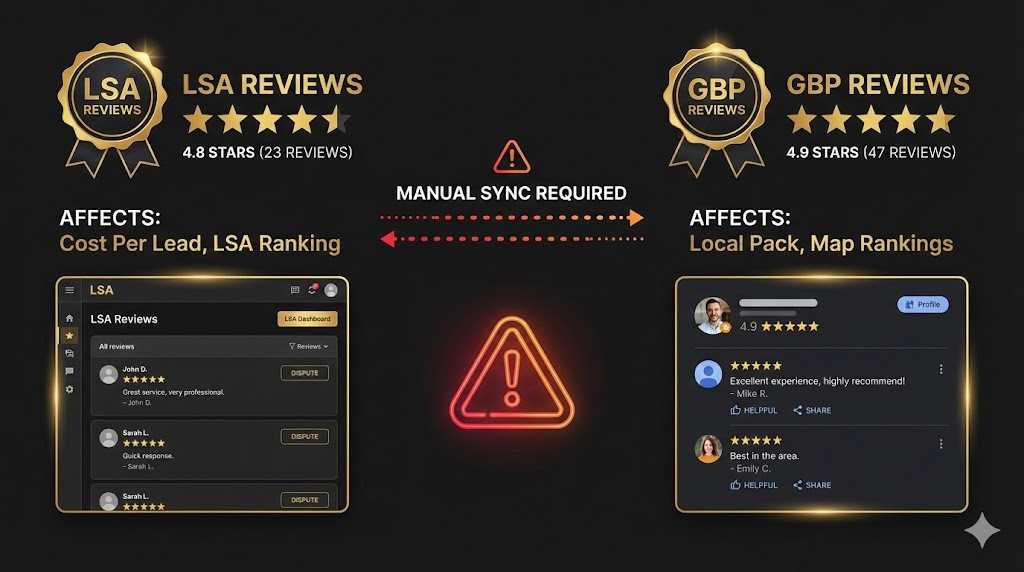
Here’s what most agents don’t realize: LSA reviews and Google Business Profile reviews are separate systems.
And it gets worse – they don’t always sync properly.
How the two review systems work:
Google Business Profile reviews:
- Affect local pack rankings (Map Pack)
- Show on Google Maps
- Appear in organic search results
- Anyone can leave a review
LSA reviews:
- Affect LSA cost per lead and ranking
- Only show in LSA section (top of search)
- Only customers you’ve marked “complete” in LSA dashboard can review
- Google “verifies” these reviews (supposedly)
The problem:
You can have 150 Google Business Profile reviews (great for organic) but only 8 LSA reviews. Google charges you MORE per LSA lead because your LSA review count is low, even though your GBP is strong.
Or you can have 50 LSA reviews but they’re not showing on your GBP, so you’re losing local pack rankings.
The sync issue:
Google *claims* LSA reviews automatically sync to GBP. They don’t. At least not reliably.
I’ve seen agents with 40 LSA reviews and only 12 showing on GBP. I’ve seen it go the other direction – 80 GBP reviews, 5 LSA reviews.
How to force the sync:
- Mark jobs complete in LSA dashboard. Every single closed deal. If you don’t mark it complete, Google won’t let the client leave an LSA review.
- Request reviews through LSA system first. After marking complete, use Google’s built-in review request. This creates the LSA review.
- Check GBP after 48 hours. See if the review appeared on your Business Profile.
- If it didn’t sync, manually request GBP review. Send them the direct GBP review link:
https://g.page/r/[YOUR_GBP_ID]/review
Yes, this means asking for two reviews sometimes. It’s annoying. But necessary.
Track both review counts separately:
- LSA reviews (affects cost per lead)
- GBP reviews (affects organic rankings)
- Overlap/sync rate
Goal: 50+ reviews in BOTH systems.
The LSA review quality filter:
LSA reviews go through Google’s “verification” process. They claim this prevents fake reviews.
In reality, it means legitimate 5-star reviews get rejected for vague reasons like “doesn’t meet quality guidelines.”
How to get LSA reviews approved:
- Tell clients to mention specifics. “Great agent” gets rejected. “Jeff helped us buy our home in Turtle Ridge and negotiated $40K off asking price” gets approved.
- Avoid generic language. “Best realtor ever!” sounds fake to Google’s filter. Specific details pass.
- Length matters. Reviews under 30 words get flagged. Aim for 50-100 words.
- Don’t ask right after closing. Wait 2-3 weeks. Reviews requested same day as job completion get flagged as potentially coerced.
The ranking impact:
LSA reviews directly affect your cost per lead. More reviews = lower cost.
Agent A: 12 LSA reviews, paying $120/lead
Agent B: 45 LSA reviews, paying $85/lead
Same market. Same service area. $35/lead difference = $8,400/year on 20 leads/month.
Get aggressive about LSA reviews. They’re money.
For more on review strategy, see the official Google Local Services Help Center.
Can I run LSAs to test markets before investing in SEO?
Yes, smart strategy for expansion.
Run LSAs in adjacent cities for 3-6 months, track conversion rates. If leads convert well (8%+), invest in SEO for that market.
Prevents wasted SEO investment in markets where you can’t compete.
