

Keyword Research in 2026: Stop Guessing What to Write About
Hey, Jeff Lenney here. If you’re still writing blog posts based on what you “feel like” talking about, you’re wasting your time. I’ve been doing SEO for 15+ years, and I still see people making this same mistake every single week.
Writing content without keyword research first is like opening a restaurant in the middle of nowhere and hoping people will magically find it. Doesn’t matter how good your food is if nobody knows you exist.
Here’s the truth: your intuition about what people want to read is probably wrong. I’ve seen it a thousand times. Someone spends weeks writing this amazing in-depth guide on a topic they’re passionate about, and it gets zero traffic because nobody’s actually searching for it.
Keywords are how people find you. They’re the bridge between what you want to say and what people are actually looking for. Skip the keyword research, and you’re just shouting into the void.
What Keyword Research Actually Means in 2026
Keyword research isn’t what it used to be. Back in the day, you’d find a keyword with high search volume, stuff it into your content 47 times, and call it a day. That’s ancient history.
Now it’s about understanding search intent. What does someone actually want when they type something into Google? Are they looking to buy something? Learn something? Compare options?
Think of it like this: if you own a fried chicken restaurant, you need customers. You could make the best chicken in the world, but if your place is in the middle of the desert with no roads leading to it, you’re going to starve.
Same thing with your website. You can have the most beautiful site, the best content, everything perfect. But if nobody can find you through search, it’s worthless. And yeah, you could pay for ads, but that gets expensive fast and stops working the second you stop paying.
Organic traffic through SEO and good keyword research? That’s the gift that keeps giving.
How I Actually Do Keyword Research (The Real Process)
Forget the theoretical BS you read in most SEO guides. Here’s how I actually do this for real clients.
Step 1: Brain Dump Your Core Topics
Start with the obvious stuff. What’s your site actually about?
Let’s say you’re in the weight loss niche. Your core topics are going to be things like nutrition, diet, fitness, workouts, meal planning, supplements, whatever.
Think about the questions people actually ask you. What do your customers want to know? What keeps them up at night?
If you’re stuck, imagine you’re building the navigation menu for your site. What are your main categories? Those are your core topics.
Step 2: Expand Each Topic into Keywords
Now take each topic and start listing out every possible keyword variation you can think of.
For “weight loss” you might have:
- how to lose weight in a day
- how to lose weight in a month
- how to lose weight in your thighs
- how to lose weight without exercise
- how to lose weight after pregnancy
Don’t ignore the long-tail keywords. Actually, focus on them. “Weight loss” is impossible to rank for. “How to lose weight in your face naturally” is way easier.
For “diet” you might have:
- best diet to lose weight
- keto diet for beginners
- intermittent fasting results
- paleo diet meal plan
- carnivore diet benefits
For “exercise”:
- best cardio for fat loss
- weight training for beginners
- bodyweight exercises at home
- how to do a proper squat
- running vs walking for weight loss
Keep going until you can’t think of anything else. You should have at least 50-100 keywords at this point. If you don’t, you’re not digging deep enough.
Step 3: Let Google Do the Work
This is where it gets good. Start typing your keywords into Google and watch what happens.
Type “how to lose weight” and Google’s autocomplete will suggest:
- how to lose weight fast
- how to lose weight in a week
- how to lose weight without exercise
- how to lose weight in your face

These are real searches from real people. Google’s showing you what’s actually trending right now.
Yeah, some of these are unrealistic. “How to lose weight in a week” isn’t a healthy approach. But people are searching for it, which means there’s an opportunity to write content that addresses this search while steering them toward something that actually works.
This is huge for understanding your audience. As content creators, we think logically. Our audience? They think emotionally and often unrealistically. Meet them where they are, then guide them to where they should be.
Step 4: Mine the “Related Searches”
Scroll to the bottom of any Google search results page. You’ll see a section called “Related searches” or “People also search for.”

These are pure gold. Google’s literally telling you what people are searching for related to your topic.
By now you should have 100+ keywords easy. Some are broad, some are specific long-tail keywords. That’s exactly what you want.
Here’s something most people miss: long-tail keywords convert better. Someone searching “weight loss” could be doing anything. Writing a paper, casual browsing, whatever. But someone searching “how to lose belly fat after 40” knows exactly what they want and they’re ready to take action.
For example, in hyper-competitive local markets, generic terms won’t work. I broke this down in my guide to real estate SEO, where “homes for sale” is useless, but “Orchard Hills gated community HOA fees” is a money keyword.
Pro Tip: Check out Keyword Shitter 2.0 (it’s free) to automate this process. Enter your keyword, and it’ll generate a massive list. Add these into Google Keyword Planner or your favorite keyword tool, sort by search volume and you’re done.
Step 5: Check What’s Actually Winnable
This is where most people screw up. They find a keyword with 100,000 searches per month and think “jackpot!” Then they spend months trying to rank for it and get nowhere.
You need to evaluate competition. How hard is it actually going to be to rank for this keyword?
Start by just Googling your keywords. Look at who’s ranking on page 1:
- Are they all massive authority sites like Healthline, WebMD, Mayo Clinic?
- Or do you see some smaller blogs in there?
- How good is their content actually?
- What’s their domain authority?
If page 1 is all giants, move on. Find something winnable.
I use Ahrefs for this. It’ll show you keyword difficulty, search volume, and who’s ranking. You can also use Google Keyword Planner (free if you have an AdWords account) but the data’s less accurate unless you’re actually running ads.
Look for keywords with decent search volume (at least 100-500 searches per month) and low to medium competition. Those are your targets.
Search Intent: The Thing Nobody Talks About
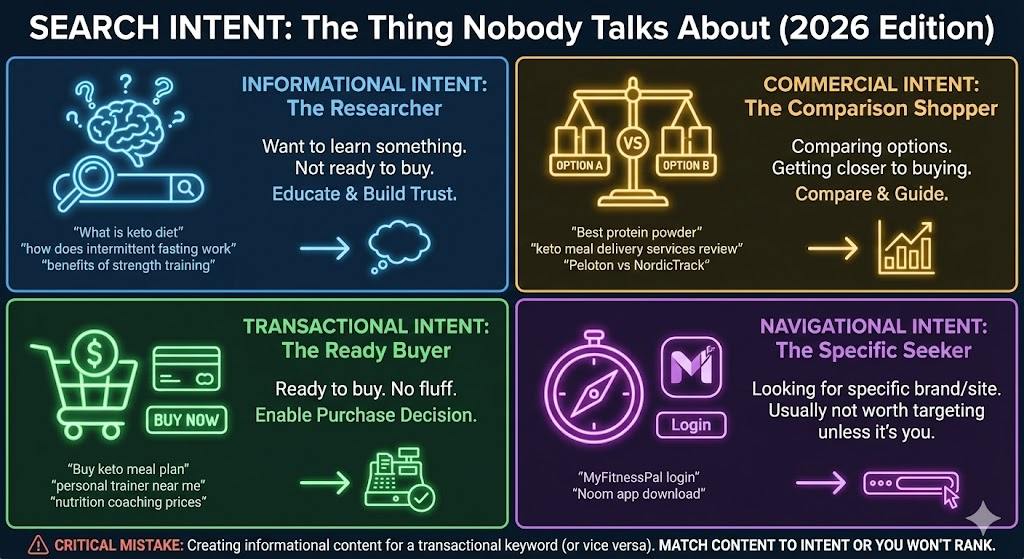
Here’s what separates good keyword research from great keyword research in 2026: understanding intent.
There are basically four types of search intent:
Informational: People want to learn something. “What is keto diet,” “how does intermittent fasting work,” “benefits of strength training.”
These people aren’t ready to buy. They’re researching. Your content should educate and build trust.
Commercial: People are comparing options. “Best protein powder,” “keto meal delivery services review,” “Peloton vs NordicTrack.”
They’re getting closer to buying. Your content should compare options honestly and guide them toward a decision.
Transactional: People are ready to buy. “Buy keto meal plan,” “personal trainer near me,” “nutrition coaching prices.”
Don’t waste their time with fluff. Give them what they need to make a purchase decision.
Navigational: People are looking for a specific brand or website. “MyFitnessPal login,” “Noom app download.”
Unless it’s your brand, these aren’t usually worth targeting.
The mistake I see constantly: someone creates an informational article trying to rank for a transactional keyword. Or vice versa. Match your content to the intent or you won’t rank.
AI and Keyword Research in 2026
Yeah, AI changed keyword research. But not in the way most people think.
AI tools can help you generate keyword ideas faster. They can analyze search intent. They can even help you understand topic clusters and semantic relationships.
But here’s what AI can’t do: tell you what will resonate with your specific audience based on your actual experience in your niche.
I use AI to speed up the research process. Generate keyword variations, analyze competitors, that kind of stuff. But the strategic decisions? That’s still human work.
If you’re relying 100% on AI-generated keyword lists without applying your own knowledge and experience, you’re going to miss the money keywords that only someone who actually knows the niche would think of.
What to Do With All These Keywords
You’ve got your list. Now what?
Organize them into content clusters. Group related keywords together. Each cluster becomes a pillar post with supporting articles.
For example, your “keto diet” cluster might include:
- Main pillar: Complete Guide to Keto Diet
- Supporting: Keto meal plan for beginners
- Supporting: Keto shopping list
- Supporting: Common keto mistakes
- Supporting: Keto and intermittent fasting
All of these link back to your main pillar post. This shows Google you’re an authority on the topic.
Target the easier, long-tail keywords first. Build up your authority. Then gradually work your way up to the more competitive terms.
And here’s something important: focus on evergreen content. Stuff that’ll be useful in 5, 10, 20 years. Yeah, you can capitalize on trending topics for traffic spikes, but your foundation should be content that doesn’t expire.
For a list of niches that stay relevant, check out my post on the most profitable evergreen niches.
Common Keyword Research Mistakes
I see these every week:
Only targeting high-volume keywords. Yeah, 100,000 searches per month sounds great. But if you can’t rank for it, who cares? Target what you can actually win.
Ignoring search intent. Creating the wrong type of content for the keyword. An informational article for a transactional keyword won’t work.
Not checking actual search results. Sometimes the keyword looks great on paper, but when you actually Google it, you realize the results are completely different from what you’d write about.
Keyword stuffing. Yes, people still do this in 2026. Stop it. Write naturally.
Only doing keyword research once. Your keyword strategy should evolve. I revisit this quarterly for my sites.
The Bottom Line
Keyword research isn’t optional. It’s the foundation of everything else you do with SEO.
You can have the best content in the world, but if it’s not targeting keywords people actually search for, you’re invisible.
The process I laid out here isn’t complicated. It just takes time and effort. Most people don’t want to do the work, which is why most people fail at SEO.
Do the research. Find winnable keywords. Match intent. Create genuinely useful content. Repeat.
That’s it. That’s the formula.
Now go actually do it instead of just reading about it.
Questions? Drop them in the comments. I actually respond to these.
